


why choose Chemical Coated Polyester Film
Film Surface Engineering
Chemical coated polyester film changes what a PET surface can do — barrier, heat, adhesion, print. Here is how each coating earns its cost, where the published numbers stop being comparable, and what to specify before you order.
Chemical coated polyester film earns its place through six measurable advantages: stronger barrier performance, higher heat resistance, tunable surface properties, promoted adhesion, reliable surface protection, and more consistent printability. Each advantage solves a specific problem that standard film cannot address on its own.
A chemical coating is a thin, applied layer that changes how the film surface behaves. It blocks gases, bonds to inks and adhesives, or resists scratches, depending on the formulation.
This guide matches those benefits to real applications and cost needs. Buyers seeking a dependable chemical coated pet film can weigh each advantage against their production demands — and against the test conditions behind every number quoted in a datasheet.
Key Takeaways
Chemical coated polyester film blocks moisture and oxygen better than uncoated film, keeping products fresh longer.
The coating helps the film handle heat, which makes it reliable for electronics and automotive parts.
Surface behaviour — scratch, fog, glare, static — can be tuned without changing the base polyester.
The coating improves adhesion, so inks and adhesives hold instead of lifting at the edges.
Coated film protects against scratches, chemicals, and UV light, which extends service life outdoors.
A receptive surface prints sharper graphics with fewer rejects and less rework.
Barrier and heat figures are only comparable when the test conditions match — ask for the report, not just the range.
Choose a supplier that offers a wide thickness range, custom options, and proof of compliance, then test samples on your own line before committing to a large order.
How Chemical Coated PET Film Improves Barrier Performance
Coating Chemistry Basics
A chemical coating works as a thin shield on the film surface. The coating formulation creates a dense layer that slows the passage of moisture, oxygen, and other gases. This layer does not change the film's core structure. It adds a functional skin that controls what passes through.
Polyester film already offers a higher moisture barrier than BOPP. Coating extends this advantage further. Biaxially oriented PET provides strong mechanical strength, dimensional stability, and chemical resistance as the base for these gains. The coating builds on that foundation.
The measured difference is large. Base PET has a water vapor transmission rate (WVTR) of 16–20 g/m²/24 hr at 38 °C and 90 % relative humidity. A PVDC coating reduces this to roughly 4–8 g/m²/24 hr. Metallization can reach below 1 g/m²/24 hr. Oxygen transmission follows the same pattern:
Metallized PET achieves an oxygen transmission rate (OTR) as low as 0.01–0.11 cc/100 in²/24 hr.
PVDC-coated PET typically falls in the 0.30–0.50 cc/100 in²/24 hr range.
These OTR values depend on the coating or metallizing layer, so total film thickness has little impact on the result. Test conditions matter just as much. Barrier figures are quoted at a stated temperature and humidity — OTR is usually run dry, WVTR at high humidity — and a value measured at 23 °C cannot be set against one measured at 38 °C. Most WVTR data comes from the infrared-sensor test method; ask which method produced the number, on which gauge, and at which conditions.
A comparison across film types shows where each option fits:
Table 1. Typical oxygen transmission of coated films. Published ranges; compare only results measured at the same temperature and humidity.
| Film type | OTR (cc/100 in²/24 hr) | OTR (cc/m²/24 hr) |
|---|---|---|
| PVdC-coated OPET | 0.30–0.50 | 4.7–7.8 |
| Metallized OPET | 0.01–0.11 | 0.16–1.7 |
| PVOH-coated OPP (AOH) | 0.02 | 0.31 |
| PVdC-coated biax Nylon-6 | 0.35–0.50 | 4.7–7.8 |
| High barrier PVdC-coated OPP | 0.30–0.60 | 4.7–9.3 |
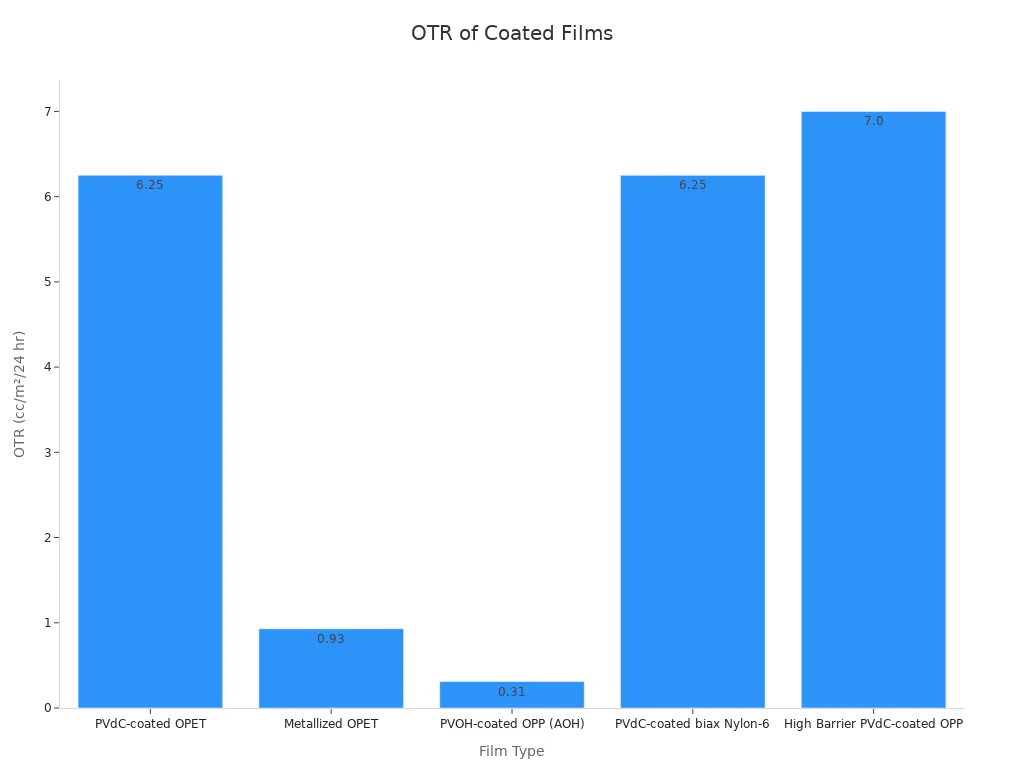
A range that spans a factor of ten is a shortlist, not a specification. When a barrier claim decides a packaging qualification, ask for the raw report: substrate grade, coating weight, gauge, temperature, relative humidity, and the instrument used. Two suppliers quoting "0.5 cc" can be describing results that differ by an order of magnitude in service.
Uncoated film still fits many applications. Dry goods with short distribution cycles, inner layers that never face moisture, and processes that prioritize cost over shelf life all work well with standard film. A chemical coated polyester film earns its cost when the product inside cannot tolerate gas or moisture ingress.
High-Barrier Applications
Food packaging demands oxygen control to prevent oxidation and flavor loss. Moisture control prevents staleness and microbial growth. A coated film extends the window of freshness for snacks, coffee, and ready meals. Pharmaceutical packaging faces stricter demands. Moisture degrades active ingredients. Oxygen breaks down sensitive compounds. Blister packs and pouch structures rely on high-barrier films to protect drug efficacy through the full shelf life.
Electronic components face corrosion from moisture and oxidation from ambient oxygen. Coated films protect printed circuit boards, sensors, and display modules during storage and transport. The barrier layer shields sensitive metallization and conductive traces from environmental attack.
Shelf-Life and Protection Gains
Barrier performance translates directly into shelf-life gains. A film that blocks moisture and oxygen slows degradation across the entire distribution chain. Products spend less time in controlled storage. Retailers reduce spoilage losses. Manufacturers cut replacement costs. The coating chemistry delivers this protection without adding significant weight or thickness to the package. For buyers comparing film options, the barrier gain often justifies the coating cost through reduced waste and longer product life.
Barrier Grade Selection
Not sure which barrier level the product actually needs?
Send the product, the target shelf life, and the storage conditions. The team will shortlist a coated grade and return the WVTR and OTR reports behind it, with the test conditions stated.
Enhanced Heat Resistance
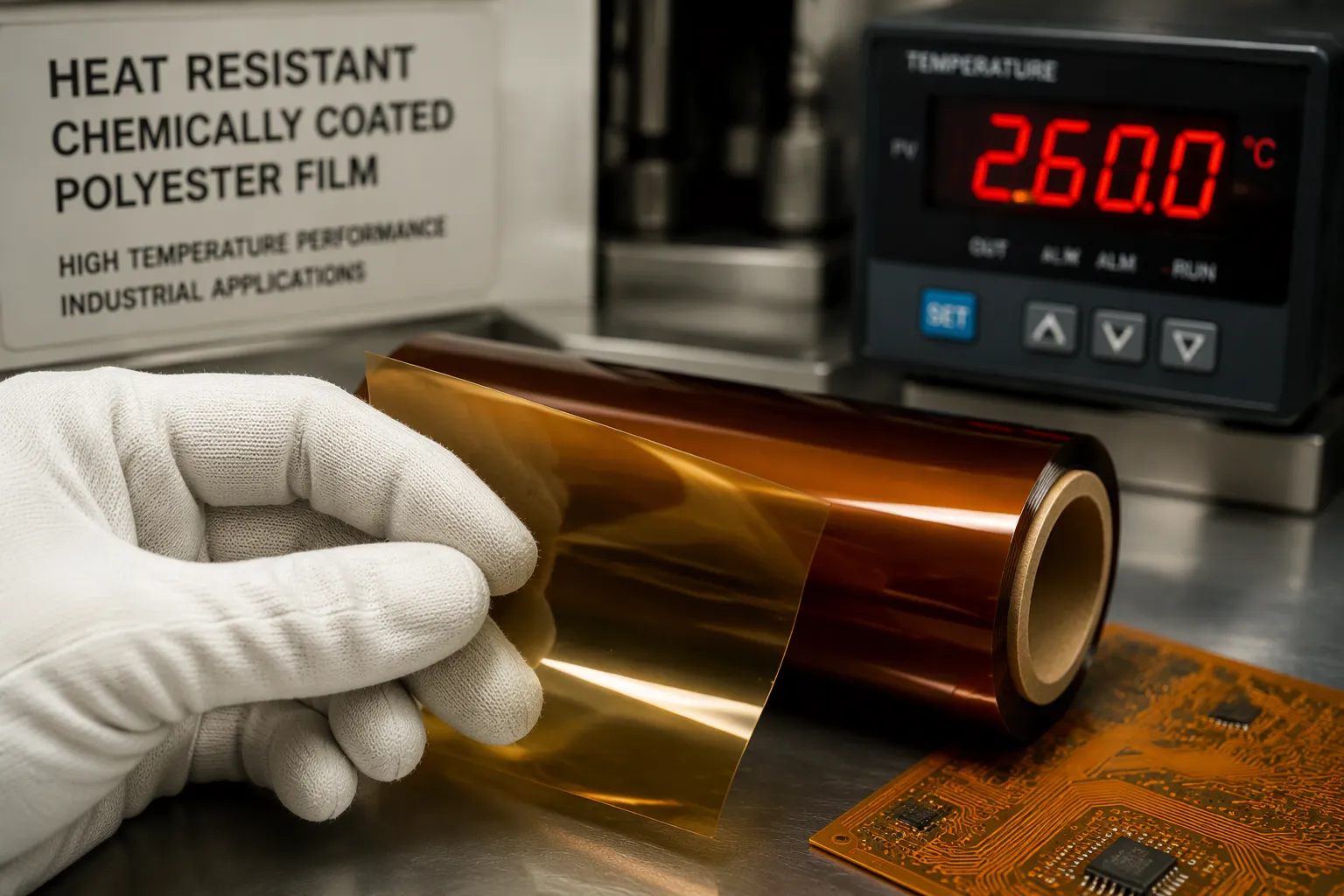
Heat exposure tests every film. Standard biaxially oriented polyester film is generally rated for continuous service around 100–120 °C, with short-term excursions to roughly 150 °C (300 °F); the polymer itself melts near 250–260 °C. Many production lines, electrical assemblies, and electronic devices push materials close to that ceiling. A chemical coating raises the film's reliability in these hot environments. The coating does not replace the base film. It reinforces how the film performs when heat builds up.
Thermal Stability from Coatings
A coating adds a protective skin that resists thermal stress. This skin helps the film hold its shape, its surface, and its bond strength as temperatures climb. The base polyester contributes its own strength. Biaxially oriented PET brings dimensional stability and chemical resistance to the pair. The coating and the base work as one system.
Heat affects film in predictable ways. The material can soften, shrink, or lose adhesion. A chemical coating slows these changes. It keeps the surface stable and protects the layers beneath. Electrical insulation and electronic components depend on this stability. A film that holds its properties under heat protects the device around it. A film that shifts under heat creates risk. The coated option reduces that risk and supports consistent performance across the product's service life.
Heat-Demanding Applications
Flexible printed circuits demand materials that resist heat and mechanical stress at the same time. The film must survive soldering, lamination, and repeated flexing without failure. Heat-stabilised grades hold their dimensions through those steps and present a stable bonding interface for downstream processing. Electrical insulation applications follow a similar logic. Motors, transformers, and slot liners generate heat during operation. A coated film keeps its insulating properties under that thermal load.
Automotive assemblies expose film to heat from engines, electronics, and exterior conditions. Under-hood components face constant thermal cycling. Industrial equipment adds its own demands. Motors, control panels, and power supplies all generate heat. A chemical coated polyester film supports these environments. The coating protects the film surface and preserves bond integrity across temperature swings. Buyers in these sectors gain a material that matches the thermal profile of the application.
Processing Reliability
Heat plays a role in lamination quality. Poor thermal control during processing leads to defects that cost time and material. Common lamination problems include delamination, curl after lamination, bubbles, low bond strength, and blocking. Each defect traces back to a specific cause. Delamination can stem from insufficient surface treatment, a contaminated film surface, an incorrect adhesive mixing ratio, or inadequate curing. Curl often reflects an imbalance between layers, such as unequal tension between PET and PE or film shrinkage differences. Bubbles signal poor contact between films, often from air entrapment or uneven coating. Blocking occurs when adjacent layers stick during storage, usually from incomplete adhesive curing or high rewind pressure.
Chemical coatings reduce several of these risks. A treated surface improves wetting and adhesive bonding. A uniform coating layer raises adhesion force and limits weak spots. The table below shows the process parameters that shape lamination results.
Table 2. Process parameters that decide lamination quality.
| Parameter | Effect on lamination |
|---|---|
| Adhesive viscosity | Influences flow and coating uniformity |
| Coating weight | Affects bond strength and adhesive consumption |
| Adhesive temperature | Influences viscosity and wetting |
| Metering accuracy | Determines cross-web consistency |
| Machine speed | Changes process conditions |
| Roller condition | Can affect coating uniformity |
Use the minimum coating weight that reliably meets performance. Too little adhesive causes insufficient wetting and weak bonding. Excess adhesive raises consumption and may affect curing and appearance.
A coated film gives operators a wider process window. Surface energy stays consistent from roll to roll. Adhesive wets the film evenly. Bond strength holds across the web. These gains cut reject rates and reduce rework on high-volume lamination lines. For a buyer weighing film options, fewer defects translate into lower total cost and steadier output.
Customized Surface Properties
Every application touches the film differently. A touch panel needs a surface that resists fingerprints. A refrigerated display lid needs a surface that sheds condensation. A converter running high-speed rolls needs a surface that slips cleanly without blocking. Chemical coatings let buyers tune these behaviors without changing the base polyester. That flexibility turns one film platform into many finished products.
Tuning Surface Energy
Surface energy controls how liquids behave on the film. A low-energy surface repels water and beads it up. A high-energy surface pulls water into a flat, even sheet. Coating formulators adjust this balance to match the end use.
Hydrophilic coatings raise surface energy. Water spreads across the film instead of forming droplets. This behavior suits anti-fog layers and printing processes that need even ink wetting. Hydrophobic coatings do the opposite. They push water away and keep the surface dry. Buyers choose between these poles based on what the film will contact. A food lid needs one behavior. An outdoor sign needs another. The coating decision follows the application, not the other way around.
Slip, Anti-Static, and Release
Film handling creates its own set of problems. Rolls stick together. Static attracts dust. Adhesives grab too hard or too softly. Coatings address each issue with a targeted formulation.
Acrylic coatings improve slip and scratch resistance at the same time. A lower coefficient of friction lets rolls unwind smoothly and reduces blocking during storage. Anti-static coatings bleed off surface charge so dust stays away from cleanroom processes and electronic components. Release coatings set how easily an adhesive lifts away, which matters for labels and tapes. A converter who matches coating to handling conditions gets fewer jams, cleaner surfaces, and steadier output. This is where a chemical coated pet film shows its practical value on the production floor.
Specialty Coating Fit
Display screens, touch panels, and optical films each demand a specific surface performance. Chemical coatings deliver these functions directly on the film.
Table 3. Specialty coatings and what each one changes at the surface.
| Coating option | Mechanism | Performance characteristics |
|---|---|---|
| Anti-fog | Hydrophilic coating on one side spreads condensed water into a thin clear layer instead of droplets | Prevents fogging through moisture and temperature swings; durable across repeated condensation cycles; food-contact grades available; may show slight haze, though high-clarity versions stay clear |
| Anti-scratch | Hard-coat layer applied to the PET surface | Protects signage and touch panels; improves abrasion resistance |
| Anti-glare | Matte-finish PET film rather than gloss | Low glare and non-reflective; easier to read under harsh light; hides fingerprints and minor scratches; suited to outdoor decals, industrial equipment labels, and machine panel overlays |
Each option solves a distinct visibility problem. Anti-fog keeps refrigerated food packaging readable when temperatures shift. Anti-glare cuts reflection on outdoor decals and machine overlays. Anti-scratch protects touch panels that face constant contact.
PET film offers low cost, high transparency, and easy large-area processing, and an anti-fog layer prevents condensation from affecting visibility on refrigerated food packaging. However, PET's surface is softer and more scratchable, so the anti-fog coating should be combined with scratch or abrasion resistance to protect the product.
Display-grade production shows what surface precision looks like in practice. The films deliver haze control, light transmittance optimization, and controlled thermal shrinkage. Production runs in dust-free environments with rigorous automatic inspection. These controls matter because a microscopic defect can disrupt brightness uniformity across a whole display module. Buyers who need this level of surface consistency should request testing data on haze, transmittance, and shrinkage before committing to a specification.
Strong Adhesion Promotion
How Coatings Improve Bonding
Untreated polyester film is chemically inert. Its surface energy sits at about 42 dynes/cm, so inks and adhesives struggle to wet it or bond to it. A chemical coating solves this problem. It applies a thin, uniform layer that modifies the polymer surface at the molecular level. Polar groups such as hydroxyl and carboxyl appear at the interface, and these groups attract inks, adhesives, and coatings. The active surface does not revert over time, unlike corona treatment, which can age out within days to weeks — faster in humid storage. The film stays permanently ready for bonding, printing, or coating.
Adhesion-promoting coatings on polyester film improve bonding to water- and solvent-based printing inks, coatings, and adhesives, as well as to metal and other substrates. These coatings ensure good wettability, which is important for strong and stable bonds to the polyester film.
Formulators build coatings around the chemistry they expect to meet. Water-based inks and coatings need high surface polarity for strong wet-out. Solvent-based inks need enhanced wetting stability. Adhesive lamination to metals, foils, or plastics needs reliable bonding across substrates. Acrylic-treated polyester films also provide good ink receptivity for solvent, UV, and latex inks. In-line chemical treatments can be tailored to specific acrylic or PU adhesives, and precision slitting up to 3200 mm supports large-scale lamination lines.
Solving Delamination
A reliable bond follows a simple surface energy rule. The substrate should sit roughly 7–10 dyne/cm above the adhesive's surface tension. Coated film meets this margin, so adhesives anchor firmly instead of lifting at the edges. Test methods confirm the result. Peel adhesion is quantified in N/25mm, measured via FINAT FTM 1 (180°) or FTM 2 (90°) at 300 mm/min, and reported after 20-minute and 24-hour dwell. ASTM D3330, the peel adhesion test, is the equivalent tape and label method. These tests expose weak anchorage before a product reaches the field.
Best-Fit Applications
Labels demand a dual behavior. The film must firmly adhere to various surfaces while remaining easy to peel off without leaving residue. Tapes need steady anchorage under repeated handling. Laminates need something more. A PET-based overlaminate matched to a polyester base film creates a homogeneous structure. Both layers are polyester, so they expand and contract at the same rate. This prevents tunneling or delamination that occurs when dissimilar materials are combined. A chemical coated pet film gives converters this same-family compatibility, and it supports printing, adhesive lamination, metallizing, and further functional coating in automotive, electronics, and construction work.
Adhesion & Surface
Matching a coating to your press or your adhesive?
Share the ink system, the adhesive chemistry, and the substrate it bonds to. The recommendation comes with surface-energy and peel data, not just a grade name.
Reliable Surface Protection
Coatings resist chemicals, abrasion, and UV radiation. That resistance safeguards surfaces in protective films, labels, and outdoor signage. A buyer who needs a film to survive handling, weather, and cleaning agents should weigh this protection carefully.
Scratch and Abrasion Resistance
Hardcoat films deliver enhanced surface protection, scratch resistance, and long-term durability for polyester film applications. Advanced hardcoat technology improves performance in demanding environments. Material integrity and appearance must hold up there.
Manufacturers apply these coatings through roll-to-roll processes. Uniform coverage, consistent thickness, and repeatable performance follow across production runs. The coatings raise scratch and abrasion resistance, and add solvent and chemical resistance for harsh environments. Higher resistance to scratches, abrasion, and chemicals reduces wear. Product performance holds over time, and product lifespan extends.
Chemical and UV Resistance
PET brings its own chemical edge. The aromatic benzene ring provides rigidity and chemical inertness, so fewer reactive sites remain for solvents to attack. Biaxial orientation aligns polymer chains into dense crystalline regions that resist solvent penetration. Topcoat selection then sets application-specific performance against MEK, acetone, and IPA.
UV protection works through several routes. Internal UV stabilizers combine hindered amine light stabilizers with UV absorbers. These neutralize free radicals and absorb harmful UV radiation within the polymer matrix. External surface coatings add a protective barrier and improve scratch and weather resistance. Antioxidants and thermal stabilizers prevent oxidation that would otherwise compound UV degradation. Accelerated weathering tests use QUV testers for fluorescent UV exposure (ASTM G154), and xenon-arc weatherometers for ASTM G155 — the two methods age a film differently, so results from one cannot be read across to the other.
The same chemistry carries into long-term outdoor work. UV blocking and hydrolysis resistance keep a film in service where plain PET would embrittle, and the CY25HTG series is designed against the 25-year service life that tier-1 solar module specifications target. Treat that figure as a design target backed by accelerated ageing data, not a warranty.
Protective Film Applications
Displays, labels, and signage each set their own surface demands. A chemical coated pet film meets them through tailored coatings rather than a single universal grade.
Table 4. Surface choice by application. Gauges are typical starting points, not limits.
| Application | Preferred surface | Typical gauge | Key requirement |
|---|---|---|---|
| Outdoor decals | Corona-treated + acrylic-coated | 100–188 µm | UV durability, strong ink anchorage |
| Appliance overlays | High-clarity CT | 125–188 µm | Low shrink, high rigidity |
| Backlit signage | Very low haze CT | 100–175 µm | Maximize light transmission |
| Protective windows | CT, controlled COF | 50–100 µm | Clean removal, scratch-resistant laminate |
| Retail labels | CT or ink-receptive | 50–125 µm | Die-cut friendly, fast application |
Display screens, touch panels, and optical films rely on customized anti-static, anti-fog, anti-scratch, and anti-glare properties. Protective windows need clean removal and a scratch-resistant laminate. Retail labels need die-cut friendliness and fast application. Outdoor decals need UV durability and strong ink anchorage. Matching gauge, haze, and coefficient of friction to the job protects the surface and keeps output consistent.
Grades behind these applications
Three positions cover most of the work: a general coated platform, a print-receptive base, and a weather-resistant grade.


Printability and Cost Efficiency
Print quality starts at the surface. A chemical coated pet film gives converters a surface engineered for ink, not just a surface that happens to accept it. That difference shows up in sharper graphics, fewer print defects, and a lower total cost across the production run.
Better Ink Reception
Ink needs sufficient surface energy to wet out and anchor to the film. When surface energy is too low, ink pulls back and beads on top. The result is uneven coverage, weak adhesion, and a real risk of scratching or peeling after the print leaves the press. Clear PET graphic film tends to provide a stable, higher-energy surface, which is why it performs well across print methods. Topcoatings go further. They modify surface energy on purpose, improve ink anchoring, and support proper curing. These benefits matter most for UV and eco-solvent printing, where a weak bond shows up fast. A good topcoat also raises post-print scratch resistance, so the graphic survives handling and shipping.
A well-matched coating keeps dots crisp and color consistent from the first roll to the last. Different printing techniques need different receptive layers, and the coating choice should follow the press.
Table 5. Receptive coatings mapped to printing process. Benefits are as stated by coating suppliers.
| Coating / primer type | Ink / printing technique | Stated benefit on films (incl. PET) |
|---|---|---|
| Water-based inkjet receptive coating (matte) | Water-based inkjet | Enables rapid absorption and drying on non-porous substrates for high-quality inkjet printing |
| HP Indigo receptive coating (water-based; solvent-based version available) | HP Indigo | Provides adhesion on plastics, papers, and synthetic substrates while holding colour quality |
| Toner receptive coatings (water-based; matte white option) | Toner technologies (e.g. iGen, Xeikon) | Allows printing on difficult-to-adhere plastics, foils, and papers; matte white finish for clear substrates |
| UV-curable ink receptive coatings (100% solids; matte/gloss options) | UV inkjet (DOD), flexo, litho | Ink-receptive surfaces, hot stampability, press polish or high gloss, adjustable matte, adhesion to treated BOPP, PS, PE, PET, and paper |
| UV ink receptive coating for film (water-based) | UV inkjet, flexo, litho | Adheres to most packaging and label films and provides UV ink receptivity with press-ready performance |
Several surface strategies support these coatings. Converters may corona treat or coat a surface to raise surface energy and improve ink, adhesive, or coating anchorage. Multilayer coextruded structures can place different functions in core and skin layers, which allows control of whiteness, stiffness, gloss, friction, antistatic performance, and print compatibility. Many polyolefin film grades need corona treatment or a printable top coating to improve surface energy and ink adhesion. Some microporous or pre-coated grades arrive ready for specific printing processes. The right combination delivers vibrant, high-resolution, fade-resistant results for labels, packaging, and decorative applications.
Lifecycle Cost Balance
Film cost is only one line in the budget. A buyer who compares purchase price alone misses the larger picture. Rejects, rework, downtime, and replacement cycles all carry a price.
A coated surface behaves the same way on every roll. Ink wets evenly. Adhesive bonds hold. Print defects drop. Each avoided reject saves material, labor, and press time. On a high-volume line, small gains in yield compound quickly. A film that runs clean the first time costs less than a cheaper film that forces a second pass.
Different film grades serve different budgets. Filled PET costs less than optical-grade PET and offers better hiding, which suits many packaging and signage jobs where opacity matters more than clarity. Optical-grade film earns its higher price in display and precision work. Neither option is wrong. The right choice depends on what the application actually needs. Buyers should weigh the upfront price against fewer rejects and a longer service life. A film that lasts longer and prints cleaner often costs less per finished unit, even when the roll price is higher.
Compliance Fit
Regulatory fit protects the buyer and the brand. A film that fails a compliance check can stall a whole production line or block a shipment.
RoHS and REACH set the baseline for material safety in electronics and consumer goods. The films are supplied against both, with test reports from a CNAS-accredited laboratory. That combination gives buyers a paper trail they can hand to their own customers. For a converter sourcing a chemical coated pet film, verified compliance removes a layer of risk from every order. The RoHS directive sets the substance limits themselves; the test report is what proves a specific roll meets them.
Environmental Fit and Choosing a Supplier
Material Efficiency and Waste
Durability is the first environmental lever. A film that resists UV, hydrolysis, and abrasion stays in service longer. Replacement cycles stretch out. Material consumption falls across the product's life. Longer life means fewer rolls produced, shipped, and discarded for the same output — a gain that shows up in the carbon account long before any recycling claim does.
Recyclability and Coating Choices
Coating selection shapes what happens at end of life. Several formulations support recycling goals without overstating what they deliver.
Table 6. Coating choice and its effect at end of life.
| Coating option | How it affects recyclability |
|---|---|
| Acrylic coated films | Solvent-free print adhesion, avoiding solvent-based layers |
| PVDC alternatives | Oxygen barrier without a chlorine-containing layer, which some recycling streams handle better |
| Metallized high-bond films | Reduce aluminum thickness while retaining moisture resistance, supporting lightweight barrier laminates |
| PVDC coated options | Extend shelf life without a multilayer structure; used in mono-material pouch designs that simplify recycling |
| Low-migration coatings (pharma) | Allow easy reclaiming of clean PET base layers |
| Bio-based coatings (water-borne, solvent-free) | Reduce VOC emissions |
Mono-material pouch designs simplify the recycling stream. Lightweight engineering with thinner gauges at equal strength cuts material use. Buyers should confirm coating chemistry against their local recycling infrastructure before making claims to customers — a coating that passes a lab test can still fall outside what a municipal stream actually accepts.
YUXING Functional Industrial Films
A reliable supplier offers more than a roll of film. Buyers should check thickness range, surface customization, production scale, and documented compliance. Jiangsu Yuxing's Functional Industrial Films cover 23–300 µm, with customizable surface properties for specific adhesives and processes. The company runs 13 production lines with 250,000-ton annual capacity, which supports large-scale lamination lines and steady supply. Compliance with RoHS and REACH, backed by a CNAS-accredited laboratory, gives buyers a paper trail for their own customers.
For a dependable chemical coated pet film manufacturer, buyers can review YUXING's capabilities at https://www.bopet-film-china.com/ and compare the coated range against the application before committing to a specification.
Chemical coated polyester film delivers measurable gains across barrier, heat resistance, surface control, adhesion, protection, and printability. Each gain translates into real application and cost benefits.
Buyers should match these benefits to their specific application, then request samples and technical data before deciding. Testing the film on the actual line removes guesswork.
Samples & Specification
Test the film on your own line before you commit
23–300 µm, primer or barrier coat, custom surface properties. Request a sample roll and the test reports — then run it through your own press, laminator, or coating line.
FAQ
What does "chemical coated" mean on a polyester film?
A chemical coating is a thin applied layer that changes how the film surface behaves. Formulators tune it to block gases, bond to inks and adhesives, or resist scratches. The base polyester keeps its strength and stability. The coating adds a functional skin on top.
How much barrier improvement does a coating deliver?
Base PET shows a water vapor transmission rate of 16–20 g/m²/24 hr at 38 °C and 90 % relative humidity. A PVDC coating brings that down to roughly 4–8 g/m²/24 hr. Metallized grades go lower still, often below 1 g/m²/24 hr. Oxygen transmission drops on the same pattern. Match the barrier grade to the shelf life the product needs, and compare only figures measured under the same conditions.
What temperature can chemical coated polyester film handle?
Standard biaxially oriented PET is rated for continuous service around 100–120 °C and short-term exposure to roughly 150 °C (300 °F); it melts near 250–260 °C. A chemical coating reinforces surface stability and bond strength as heat builds, but it does not raise the melting point of the core. Electrical insulation, flexible circuits, and automotive assemblies are the fit applications. Confirm the thermal profile of your own process before specifying a grade.
Can the surface properties be customized?
Yes. Coatings can raise or lower surface energy, add anti-static or release behavior, or deliver anti-fog, anti-glare, and anti-scratch performance. Converters pick the formulation that matches their handling and end use. One film platform then serves many finished products.
Why does uncoated PET resist inks and adhesives?
Untreated polyester is chemically inert, with surface energy around 42 dynes/cm. Inks and adhesives struggle to wet it. A chemical coating adds polar groups at the interface, so bonding holds. The treated surface also stays active over time, unlike corona treatment, which can age out within days to weeks.
Does the coating cost pay back?
A coated roll costs more upfront. The payback comes from fewer rejects, less rework, and longer service life. Filled PET costs less than optical-grade PET and offers better hiding, so it fits packaging and signage jobs. Weigh roll price against cost per finished unit, not against the price on the invoice alone.
Which standards should a buyer verify?
RoHS and REACH set the baseline for material safety in electronics and consumer goods. On the technical side, barrier is measured to ASTM F1249, peel adhesion to ASTM D3330 or FINAT FTM 1/2, and UV ageing to ASTM G154 or G155. A CNAS-accredited laboratory backs the test data. Verified compliance gives buyers a paper trail for their own customers and removes risk from every order.
How does a buyer choose a chemical coated PET film supplier?
Check thickness range, surface customization, production scale, and documented compliance. YUXING Functional Industrial Films cover 23–300 µm, run on 13 production lines with 250,000-ton annual capacity, and meet RoHS and REACH. Buyers can request samples and technical data at https://www.bopet-film-china.com/ before committing to a specification.
Sources
ASTM F1249, Standard Test Method for Water Vapor Transmission Rate Through Plastic Film and Sheeting Using a Modulated Infrared Sensor. Read the WVTR test method
ASTM D3330/D3330M, Standard Test Method for Peel Adhesion of Pressure-Sensitive Tape. Read the peel adhesion method
ASTM G154, Standard Practice for Operating Fluorescent Ultraviolet (UV) Lamp Apparatus for Exposure of Nonmetallic Materials. Read the UV exposure practice
European Commission, Directive 2011/65/EU on the restriction of the use of certain hazardous substances in electrical and electronic equipment (RoHS). Read the directive