


What Are The Advantages Of PET Film Products?
Key Benefits of PET Film Products for Modern Industries
Updated: 2026-09-21
PET film products combine strength, clarity, barrier performance, and cost-efficiency in ways modern industries depend on every day. This material supports durability, optical clarity, barrier protection, cost-effectiveness, and recyclability — five benefits that shape how manufacturers choose their substrates. The global BOPET film market continues to expand as demand from packaging, electronics, automotive, and medical sectors rises. So why do so many industries pick PET film over alternatives? The answer becomes clearer when you connect each benefit to real applications in packaging, electronics, automotive, and medical sectors. Buyers who value consistent quality and a dependable supplier will find these advantages matter more than ever.
Key Takeaways
PET film offers five key benefits: durability, clarity, barrier protection, cost-effectiveness, and recyclability.
Its biaxial stretching process makes PET film three to four times stronger than PVC film.
PET film maintains stability from -70°C to 150°C, handling extreme temperatures better than BOPP.
High light transmission and low haze make PET film ideal for displays and optical applications.
PET film provides excellent moisture and oxygen barrier, extending product shelf life.
Lightweight and easy to convert, PET film reduces shipping costs and production waste.
PET film is recyclable and carries a lower carbon footprint than aluminum, with a lighter weight than glass.
Choose PET film for reliable performance in packaging, electronics, automotive, and medical industries.
What Is PET Film and Why It Matters
A Clear Definition of PET Film
Chemical makeup and film formation
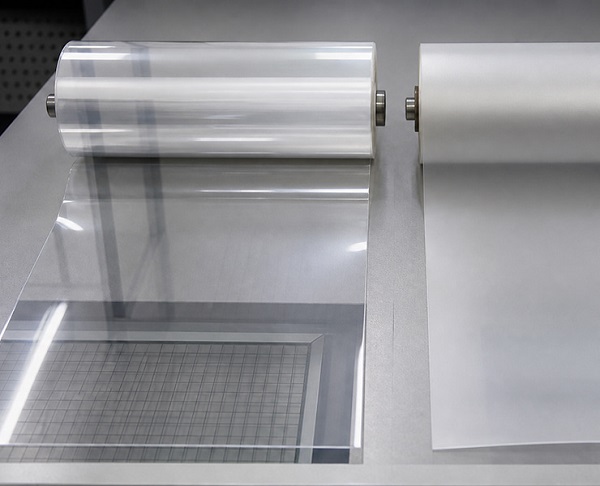
PET film starts as polyethylene terephthalate, a polymer formed through the reaction of terephthalic acid and ethylene glycol. Manufacturers extrude this polymer into a thick sheet and then stretch it in two directions — machine direction and transverse direction. This biaxial stretching process aligns the polymer chains and directly enhances the film's strength and clarity. The resulting biaxially oriented polyethylene terephthalate, or BOPET, delivers high tensile strength, dimensional stability, and excellent optical clarity. These qualities make the material suitable for packaging and display applications. The biaxial orientation process involves several controlled stages. The table below summarizes how each stage affects mechanical strength and optical clarity.
| Process Stage | Conditions | Effect on Mechanical Strength & Optical Clarity |
|---|---|---|
| Biaxial stretching (sequential) | Preheated to 80–110°C; stretched in machine direction at draw ratio 3.0–4.5×; then transverse direction at 90–130°C with draw ratio 3.5–4.5× | Induces molecular orientation and crystallization, aligning polymer chains to enhance tensile strength and clarity |
| Biaxial stretching (simultaneous) | Stretched in both directions concurrently at 95–120°C using a linear motor-driven tenter | Yields more balanced properties and reduced thickness variation, supporting uniform strength and optical quality |
| Heat-setting | 200–240°C for 3–30 seconds under controlled tension (0–5% relaxation in TD) | Stabilizes the oriented structure and develops crystallinity; crystallization index tuned to 25–55 J/g |
| Crystallinity trade-off | Higher crystallization index (45–55 J/g) vs lower (25–35 J/g) | Higher values give superior dimensional stability but reduce flexibility; lower values enhance impact resistance at the expense of heat resistance |
| Final film | Thickness 10–150 μm; thickness uniformity typically ±3% across web width | Uniform thickness supports consistent mechanical performance and optical clarity |
Common thickness ranges and treatments
Manufacturers like Yuxing Film Technology Co., Ltd. produce BOPET film in thicknesses from 36 to 500 µm. This wide range enables precise control over film properties for different applications. A Chinese BOPET film manufacturer with over 60 years of expertise, Yuxing operates 13 production lines with a maximum effective line width of 6.5 meters and an annual capacity of 250,000 tons. Surface treatments — such as corona treatment, chemical coating, or primer application — further modify the film for printing, adhesion, or barrier enhancement.
Properties That Set PET Film Apart
Mechanical strength and dimensional stability
BOPET film outperforms many polymer alternatives in mechanical strength. Compared to BOPP, which shows poor tensile strength, BOPET delivers good tensile performance. The biaxial orientation and crystallization of polymer chains during manufacturing produce exceptional mechanical strength and wear resistance while maintaining transparency. This durability makes PET film a reliable choice for demanding applications.
Thermal and chemical resistance
BOPET film operates across a temperature range of -70 to 150°C. BOPP film, by contrast, handles only -50 to 120°C. This broader thermal window allows BOPET to perform in environments where other films would soften or degrade. The material also resists many chemicals, oils, and solvents, which protects sensitive components during processing and end use.
Why These Properties Matter Today
Demands of high-speed manufacturing and long shelf life
Modern production lines run at high speeds and require substrates that resist tearing, stretching, or deformation. BOPET film meets these demands through its dimensional stability and consistent thickness uniformity. The material's air barrier performance rates as good, matching BOPA and exceeding BOPP. For packaging applications, this barrier extends shelf life and protects contents from oxygen degradation. Liquid barrier performance sits at an acceptable level — better than BOPA but below BOPP — which suits many food and consumer goods applications.
Long shelf life also depends on thermal stability. Products stored in warehouses or transported through varying climates must withstand temperature fluctuations without losing integrity. BOPET film handles this challenge well. Its resistance to humidity and heat means that packaged goods, electronic components, and medical supplies remain protected over extended periods. These combined properties explain why industries choose BOPET film over alternatives. The material balances strength, clarity, thermal range, and barrier performance in ways that support efficient manufacturing and reliable product performance.
Core Benefit — Durability and Strength
Manufacturers choose PET film for demanding applications because it withstands physical stress better than many common alternatives. The material's biaxial orientation creates a structure that resists tearing, stretching, and fatigue over repeated handling cycles. This durability reduces material waste during production and extends the working life of finished products.
Resistance to Tearing and Fatigue
Performance under repeated handling
PET film delivers tensile strength in the range of 170 to 250 MPa. For comparison, PVC film offers only 40 to 60 MPa. This difference means PET film handles roughly three to four times more pulling force before breaking. The table below shows how stretching conditions affect the final tensile strength.
| Condition | Tensile Strength (MPa) |
|---|---|
| Unstretched (25.4 μm) | 176 |
| Stretched (25.4 μm) | 281 |
| Two-way stretch and post-stretch | 267 |
The biaxial stretching process aligns polymer chains in both directions. This alignment provides balanced strength across the film's width and length. When a package or component undergoes repeated bending, folding, or vibration, PET film maintains its integrity. It does not develop micro-cracks or propagate tears as readily as less oriented materials.
In high-speed manufacturing lines, films experience constant tension and flexing. PET film resists fatigue failure under these conditions. A converter can run the material at high speeds without worrying about sudden web breaks or edge tears. This reliability translates into fewer production interruptions and less scrap material.
Stability Across Temperature and Humidity
Dimensional consistency in demanding environments
PET film maintains its shape and size across a broad temperature range. The material operates from -70°C to 150°C with only minimal dimensional change under normal operating conditions. BOPP film functions only between -50°C and 120°C. This wider window matters for applications that experience heat during lamination, coating, or end use.
Humidity also affects polymer films. Some materials absorb moisture and swell, causing dimensional shifts that ruin registration in printing or alignment in electronic assemblies. PET film resists moisture absorption well. Its low water vapor transmission rate keeps the film stable even in humid production environments. For applications like electrical insulation or display backings, dimensional stability is critical. A film that shrinks or expands with temperature changes can cause short circuits or optical distortions. PET film's heat-setting step during manufacturing locks in the oriented structure. The film then shows minimal thermal shrinkage under normal operating conditions.
Long Service Life and Lower Replacement Costs
Impact on maintenance and downtime
A durable material reduces the frequency of replacement. For packaging lines, PET film's tear resistance means fewer line stoppages to clear broken material. For electrical insulation, the material's thermal and mechanical stability means components last longer without failure. Each avoided failure saves maintenance labor, replacement part costs, and lost production time.
The choice of film directly affects total cost of ownership. A cheaper but weaker material may tear during processing or degrade faster in service. PET film's higher initial cost per unit area offsets itself through fewer failures and longer intervals between replacements. Engineers who evaluate material costs over the full product lifecycle often find PET film delivers better value. In applications where downtime carries a high penalty, such as continuous manufacturing or critical medical devices, reliability becomes the primary selection criterion. PET film's proven durability and consistent quality make it a trusted choice for these demanding situations.
Core Benefit — Optical Clarity and Appearance
High Light Transmission and Low Haze
Importance for display and inspection
Optical clarity determines how well a film performs in display and inspection applications. High light transmission allows more light to pass through the material. Low haze prevents light from scattering, which keeps images sharp and colors accurate. These two properties work together to support screens, monitors, and optical devices.
Industry benchmarks show what optical-grade films can achieve. Yuxing's CY20CM Window Film delivers super high transmittance between 89.81% and 89.54%. Its haze measures as low as 0.8% to 1.01%. These values represent the performance level that display manufacturers expect from premium substrates. Optical grade BOPET films serve as diffusion layers, reflection layers, and pre-coating base films. LCD backlight units rely on these films to distribute light evenly across the screen. OLED protection layers use them to maintain image quality while shielding sensitive components. Industrial monitors also depend on optical films that resist yellowing and maintain clarity over years of operation.
Consistent Surface for Printing and Coating
Supporting brand presentation and readability
A uniform surface ensures that inks, adhesives, and coatings bond evenly across the film. Surface variations cause print defects, poor adhesion, and inconsistent appearance. These problems damage brand presentation and reduce readability. Manufacturers address this challenge through surface treatments. Corona treatment raises surface energy for better ink wetting. Chemical treatment adds functional groups that improve coating adhesion. Custom priming creates a tailored surface for specific inks or adhesives.
The quality of the printed surface directly affects how consumers perceive a product. Sharp text and vibrant graphics communicate quality and build trust. Blurred or uneven printing suggests poor manufacturing standards. For labels and packaging, the film surface must accept inks without bleeding or smearing. It must also resist scuffing during handling and shipping. A consistent surface helps converters achieve reliable results on high-speed presses. It reduces waste from misprints and rework.
Aesthetic Versatility Across Applications
Gloss, matte, and metallized finishes
PET film supports a wide range of surface finishes that serve different aesthetic and functional needs. Matte film uses a special PET master batch to create medium haze and medium gloss. This produces a muted, grainy surface rather than a reflective one. Metallized versions deliver a premium silver finish after vacuum deposition of aluminum. The table below compares gloss and matte films across key attributes.
| Attribute | Gloss PET Film | Matte PET Film |
|---|---|---|
| Appearance | Shiny, high-gloss finish with vibrant shine | Flat, non-reflective finish with a subdued look |
| Glare in light | Can produce glare under bright light | Low glare, easier to read under harsh light |
| Print color vibrancy | Colors appear very bold and saturated | Colors slightly muted, giving a soft, premium appearance |
| Fingerprints & scratches | Fingerprints and scratches are more visible | Hides fingerprints and minor scratches better |
| Typical uses | Product labels needing shelf pop, clear bottle labels for the no-label look, high-gloss stickers | Industrial equipment labels, outdoor decals to reduce glare, applications needing a writable or scuff-resistant surface |
Metallized films add another dimension. Bright mirror metallized film offers maximum reflectivity with an optical density of 2.5 or higher. Matte metallized label film creates a soft, non-glare metallic look. Holographic aluminized film embosses a diffraction grating pattern into the aluminum surface. Transparent barrier metallized film uses low optical density between 0.8 and 1.5. This allows some light to pass through while retaining a metallic aesthetic. After metallization, most label-grade films receive a lacquer topcoat or printable primer. This shields the aluminum from oxidation and provides a receptive surface for printing inks.
Core Benefit — Barrier and Protective Properties
How PET Film Delivers Barrier Protection
Moisture and oxygen barrier performance
Barrier performance determines how well a film keeps moisture and oxygen away from sensitive contents. PET film blocks these elements at levels that suit many packaging and industrial uses. Thicker films generally block more than thin ones, as the table below shows.
| PET Film Thickness (micrometers) | Typical OTR (cc/m²/day) | Typical WVTR (g/m²/day) |
|---|---|---|
| 12 | 70–90 | 7–10 |
| 24 | 35–45 | 3.5–5 |
| 50 | 17–23 | 1.7–2.5 |
A standard PET film sample shows an OTR of 45–65 cc/m²/day and a WVTR of 3–5 g/m²/day. These values give engineers a baseline for comparing grades. OTR is typically measured using standards such as ASTM D3985[1], while WVTR is measured using ASTM F1249[2]. These protocols specify testing at controlled conditions, such as 23°C and 0% or 90% relative humidity.
Protection Against Contaminants and Chemicals
Safeguarding sensitive components
PET film resists water, oils, and many solvents. This resistance protects products that may contain or be exposed to chemicals. Food and beverage packaging relies on this trait to preserve freshness. Electronics use it to shield flexible circuits and insulation from process chemistries. Medical and pharmaceutical packaging benefits from resistance to oils and greases, which keeps medications, devices, and kits safe. Healthcare and personal care items, such as alcohol or solvent wipes, also depend on this durability. Adhesives, inks, and process chemistries interact with the film during manufacturing, and its chemical stability keeps those interactions predictable.
Compatibility with Coatings and Laminates
Enhancing barrier function for specialized needs
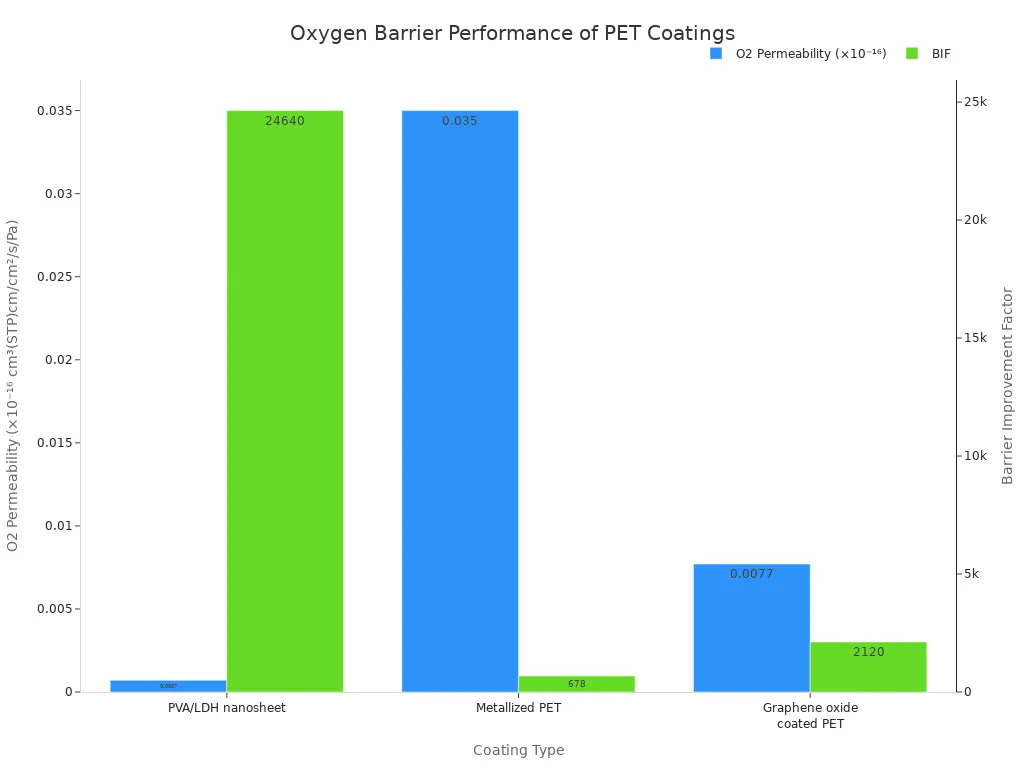
Base PET film often receives additional coatings to raise its barrier performance. Oxide coatings such as SiOx or AlOx create transparent, high-barrier options for food packaging where product visibility matters, for example in nutraceutical packaging. Other common coatings include metallized, acrylic, aluminum oxide, PVDC, copolymer, and chemical-treated layers. Corona treatment prepares the surface for better adhesion. Coating choice changes performance. A PVA/LDH nanosheet coating[3] reaches an O2 permeability of ≤0.0007×10⁻¹⁶ cm³(STP)cm/cm²/s/Pa with a barrier improvement factor of at least 24640, and a WVTR as low as 0.04 g/m²/day at 23°C and 50% RH. Metallized PET shows an O2 permeability of 0.035×10⁻¹⁶ and a barrier improvement factor of 678. Graphene oxide coated PET reaches 0.0077×10⁻¹⁶ and a factor of 2120. These options let converters match barrier strength to the product's shelf-life needs.
Core Benefit — Cost-Effectiveness and Efficiency
Competitive Material Cost per Square Meter
Comparison with alternative substrates
Cost per square meter drives material selection for high-volume production. PET film competes well against PVC, BOPP, and paper substrates on a cost-per-performance basis. PVC film offers lower tensile strength, so converters need thicker gauges to match PET film's load-bearing capacity. That extra thickness raises the effective cost per square meter. BOPP costs less per kilogram in some markets, yet its narrower thermal window limits where it can run. Engineers who compare total material usage often find that PET film delivers more usable area per dollar.
Price alone does not determine value. A substrate that tears during conversion creates scrap, rework, and downtime. Those hidden costs push the true cost per finished unit far above the quoted material price. Buyers who evaluate suppliers on quality and consistency usually discover that a stable, high-yield film lowers the effective cost per saleable part. Volume purchasing also matters. Large manufacturers with wide production lines spread fixed costs across more square meters, which improves unit economics for every customer downstream.
Lightweight Nature That Lowers Shipping Costs
Fuel and logistics savings in distribution
Thin films weigh very little relative to the area they cover. A roll of PET film at 36 µm thickness carries far less mass than a comparable roll of thicker substrate. Lower mass translates directly into lower freight charges. Air freight, ocean freight, and parcel carriers all price shipments by weight or dimensional weight. Lighter rolls reduce both.
Distribution networks benefit in other ways. Warehouses can store more film per pallet position. Trucks can carry more square meters per load. Each avoided truck trip cuts fuel consumption and carbon emissions. For exporters, the savings compound across long supply chains. A manufacturer shipping film to overseas coating specialists saves on every leg of the journey. Those logistics savings flow back to the buyer through lower landed cost.
Easy Conversion on Standard Equipment
Reducing setup time and waste in production
PET film runs on standard coating, laminating, printing, and slitting equipment. Converters do not need specialized machinery to process it. Corona treatment and primer coatings prepare the surface for inks and adhesives using familiar processes. This compatibility shortens setup time for new jobs. Operators already know how the material behaves, so they reach target line speeds faster.
Consistent thickness uniformity also reduces waste. Film that varies in gauge causes registration errors, coating defects, and web breaks. Stable film keeps the process within tolerance and cuts startup scrap. Less waste means more saleable output from the same raw material input. Over a production run, those savings add up to meaningful cost reductions. A reliable material also lowers the labor burden on operators, who spend less time troubleshooting and more time producing.
Core Benefit — Sustainability and Recyclability
Recyclability of PET Film Streams
Existing recycling infrastructure and challenges
PET film belongs to the most recycled plastic family in the world. Bottle-grade PET has a well-established collection and processing network. Film streams, however, face a different reality. Multi-layer flexible packaging combines polymers such as PE, PP, PET, and PA with aluminum barriers, adhesives, inks, and coatings. These layers deliver oxygen barriers and puncture resistance, yet they create technical barriers to recycling.
| Challenge Category | Explanation |
|---|---|
| Material complexity | Multi-layer flexible packaging combines polymers such as PE, PP, PET, and PA with aluminum barriers, adhesives, inks, and coatings to achieve performance features like oxygen barriers and puncture resistance, creating technical barriers to recycling. |
| Contamination & feedstock quality | Recycling flexible plastics demands highly consistent, high-quality feedstock, and even small impurities can negatively affect manufacturing performance. |
| Economic barriers | Recycled films struggle to compete with virgin resin, which benefits from large-scale, optimized supply chains and significant cost advantages; recycling for flexibles remains small and fragmented. |
| Weak end markets | Without reliable end markets willing to purchase recyclates at scale, investment in collection, sorting, and recycling infrastructure remains constrained. |
| Sorting technology cost | Advanced technologies needed to separate flexible packaging waste into different fractions are expensive, limiting adoption at the scale of individual recyclers. |
Mono-material PET film designs simplify the sorting process. Brands that choose mono-layer or easily separable structures help recyclers recover more clean feedstock. Suppliers who invest in design-for-recycling principles make the entire chain more viable.
Lower Carbon Footprint Than Many Alternatives
Energy use in production and transport
Production energy shapes the carbon profile of any material. PET film carries a lower burden than several common alternatives. Virgin PET (applicable to PET film): 2.0–3.5 kg CO₂e per kg. Glass: 1.5–4.0 kg CO₂e per kg. Primary Aluminum: 8–16 kg CO₂e per kg. Aluminum production requires far more energy per kilogram. Glass falls in a similar range to PET, yet glass weighs much more per unit area. That weight raises transport emissions across the supply chain. PET film's lightweight nature lowers fuel use at every shipping stage. A converter who ships film instead of glass or metal moves far less mass per square meter of finished product.
Growing Demand for Eco-Conscious Materials
How PET film supports brand sustainability goals
Consumer demand for sustainable packaging has become a major growth driver for the PET film market. Rising eco-consciousness and stricter regulations favoring recyclable materials are pushing manufacturers to innovate with recyclable, biodegradable, and bio-based PET films. This shift is expanding PET film applications across food and beverage, pharmaceuticals, and consumer goods. It also encourages investments in barrier coatings, anti-fog properties, and enhanced printability to meet both performance and sustainability expectations. Brands that adopt sustainable practices see stronger customer loyalty. E-commerce expands the reach of eco-friendly PET film products even further. A quality supplier who offers recyclable grades helps brands meet these goals without sacrificing performance.
Types of PET Film and Their Uses
Standard, Treated, and Coated Films
When to choose each type
Manufacturers classify BOPET film by surface treatment and additive blending. The choice depends on the bonding, printing, or barrier needs of the final product.
Untreated plain BOPET: used where surface treatment is not required.
Corona-treated plain BOPET: enhances surface energy and improves ink or adhesive bonding.
Single-side treated BOPET.
Double-side treated BOPET.
A converter who needs strong ink adhesion on one side chooses single-side corona treatment. A converter who needs adhesion on both sides chooses double-side treatment. Untreated film suits applications where the surface remains hidden or where no coating will bond to it. Coated films add a functional layer, such as a primer or a barrier coating, on top of the base film. These films cost more per square meter, yet they deliver performance that plain film cannot match.
Specialty Films for High-Performance Needs
Heat-stabilized, flame-retardant, and optical grades
Specialty grades solve problems that standard film cannot handle. Heat-stabilized films resist shrinkage during high-temperature processing. Flame-retardant films meet strict safety standards. Torelina™ film is described as self-extinguishing, and films thicker than 25 µm are approved under UL 94 as VTM-0 grade.
| Property | UL 94 V-0 Requirement (as described) |
|---|---|
| Rating | UL 94 V-0 (Vertical Burn) |
| Thickness range | 25–100 microns |
| Burn time | Stops burning within 10 seconds on a vertical specimen |
| Drip behavior | Drips allowed, but must not be inflamed |
| Test observations | Burning rate, afterglow, and dripping behavior are recorded |
| Standard body | Underwriters Laboratories (UL) |
Optical grades serve display and lighting applications. They deliver high light transmission and low haze. A buyer who needs a flame-retardant grade for electrical insulation should verify the UL rating and thickness range before ordering. A buyer who needs an optical grade should request transmittance and haze data from the supplier.
Matching Film Type to Industry Needs
Aligning benefit priorities with application requirements
Different industries prioritize different film properties. Yuxing organizes its core product portfolio by function to help engineers find the right specification.
Optical Grade BOPET Films include diffusion, reflection, and pre-coating base films.
Electrical Insulation Films are UL-recognized and serve traction motors, transformers, and wire applications, with ultra-thick capabilities.
Functional Industrial Films support solar photovoltaic backsheets, battery encapsulation, medical X-ray films, and textile applications.
Surface Appearance Films offer customized matte and colored finishes for consumer electronics, window film, paint protection, and panel decoration.
Technical specifications help buyers match film to task. The CY30YS Compressor Film delivers electrical strength of at least 90 V/μm and tensile strength of at least 150 MPa. The F40 Reflective Film uses a diffusion base and withstands heat at 60°C and 90% relative humidity for 500 hours. A CNAS-accredited laboratory and full RoHS and REACH compliance support consistent international-standard performance. Engineers who choose a supplier with these credentials reduce the risk of batch-to-batch variation.
Applications Across Modern Industries
Packaging and Labeling
Food, beverage, and consumer goods protection
The food and beverage industry remains the largest end-user of PET film packaging. This sector demands high-barrier, transparent, and tamper-evident materials. Convenience foods require extended shelf life, and PET film delivers the necessary oxygen and moisture protection. The material's clarity lets consumers see the product inside, which directly drives purchase decisions. Its dimensional stability supports high-speed filling lines without web breaks or misregistration. For products sensitive to light or oxidation, PET film accepts metallized coatings that block UV radiation while maintaining mechanical integrity.
The pharmaceutical industry also depends on PET film for blister packaging and sterile barriers. These packages maintain drug stability and prevent contamination. Growth in global healthcare and the development of sensitive medications push demand for reliable packaging substrates. PET film provides a consistent barrier profile that protects contents from oxygen and moisture ingress. The material's compatibility with coatings and laminates allows converters to fine-tune barrier performance for each drug formulation. Suppliers who offer traceable film lots help pharmaceutical companies meet strict regulatory requirements for lot traceability.
Consumer goods packaging follows the same logic. Brands choose PET film when they need printability, clarity, and protection in one substrate. Labels and flexible pouches benefit from the material's ability to accept high-quality graphics while shielding contents from environmental damage. The lightweight nature also reduces shipping costs for packaged goods, an advantage that matters more as logistics expenses continue rising.
Electronics and Display Technologies
Insulation, screens, and flexible circuits
PET film serves multiple critical roles in electronics. It acts as a substrate for flexible printed circuits, as a base film for displays, and as electrical insulation in motors and transformers. Flexible electronics use PET as a cost-effective substrate. The material is not moisture-sensitive and can be made fully transparent. Screen-printed devices on ordinary PET require barrier film lamination on both sides[4] to achieve proper encapsulation. Screen-printing of the devices has been carried out on both ordinary PET substrates and different barrier films, and the encapsulation is completed by lamination of different barrier films using screen-printed adhesive frames. This approach works well for OLED displays, where PET allows the entire stack to remain very thin. Plastics such as PET and TAC serve as the main substrates because they keep the device lightweight and flexible. The combination of organic transistors with a plastic substrate rather than glass reduces overall size and weight substantially.
For electrical insulation, PET film meets demanding requirements in motor applications. The table below shows typical specifications for slot liner applications.
| Requirement | Class B (130°C) | Class F (155°C) |
|---|---|---|
| Thickness range | 0.125–0.25 mm single layer; 0.20–0.35 mm composite | 0.20–0.35 mm |
| Voltage rating | Up to 600 V | Up to 600 V |
| Temperature limit | 130°C (PET core) | 155°C (PET core in composite) |
| Mechanical protection | Polyester fleece for cushioning | Nomex outer layers for puncture resistance |
| Typical motor size | Fractional-HP to small industrial | 1 HP to 500 HP industrial motors |
PET film delivers high dielectric strength, good dimensional stability under thermal and mechanical stress, and excellent resistance to abrasion, chemicals, and UV radiation. Its resistance to creep and stress cracking proves critical for vibration-prone motor environments. Engineers who specify PET for insulation reduce the risk of premature failure in demanding industrial applications.
Automotive, Medical, and Industrial Uses
Safety, sterilization, and performance demands
Medical device packaging places strict demands on film performance. ISO 11607[5] requires the sterile barrier system to maintain integrity through sterilization, handling, storage, transport, and distribution. ASTM F1980 supports accelerated aging for shelf-life determination, but real-time aging data must confirm the results. Qualification includes seal integrity testing after sterilization, mechanical property evaluation after both sterilization and aging, and dimensional stability assessment with visual inspection for discoloration or distortion.
Sterilization method compatibility is a critical factor. PET handles ethylene oxide (EtO) sterilization without significant property change. Under gamma and e-beam radiation, PET maintains mechanical properties and barrier performance, though slight yellowing may occur at high doses. The table below summarizes key requirements.
| Requirement | EtO Sterilization | Gamma / E-Beam |
|---|---|---|
| PET compatibility | Excellent | Excellent |
| Barrier target (OTR) | 2–6 cc/100 in²/24 hr | 2–6 cc/100 in²/24 hr |
| Cleanliness level | ISO Class 8–7 | ISO Class 7–6 |
| Lot traceability | Required | Required |
For irradiated materials, performance must be validated at both minimum and maximum dose within the established range. EtO sterilization requires packaging that is permeable to the sterilant gas. Non-porous polymer films with low gas permeability generally do not work as the primary sterile barrier in EtO applications. PET/PE structures maintain their physical properties without yellowing or becoming brittle under both EtO and gamma radiation, meeting key requirements for global regulatory compliance.
The automotive and industrial sectors also benefit from PET film's performance profile. The material serves as protective layers, insulation, and release liners in electric vehicles, renewable energy systems, and 5G infrastructure. Its dimensional stability and chemical resistance make it suitable for demanding environments where reliability matters most. Engineers across these industries choose PET film when they need consistent quality and predictable performance from their material supplier.
PET film delivers durability, optical clarity, barrier protection, cost-effectiveness, and recyclability in one material. These five benefits explain why packaging, electronics, automotive, and medical industries keep choosing it. Modern manufacturers face pressure to cut costs, improve quality, and meet environmental goals. PET film helps them address all three at once. Buyers who evaluate suppliers should look for consistent quality and dependable support. As industries demand more from their materials, PET film's role will only grow.
FAQ
What is the difference between PET film and BOPET film?
BOPET stands for biaxially oriented PET. Manufacturers stretch the film in two directions during production. This process aligns polymer chains and gives BOPET superior strength, clarity, and dimensional stability compared to non-oriented versions.
Is PET film recyclable?
PET belongs to the most recycled plastic family. Bottle-grade material has a well-established recycling network. Film streams face more challenges due to multi-layer structures and coatings. Mono-material designs simplify sorting and improve recyclability rates.
What thickness of PET film suits a specific application?
Manufacturers produce PET film from 36 to 500 µm. Thinner options suit packaging and labeling. Thicker versions serve electrical insulation and industrial uses. The best choice depends on mechanical strength, barrier needs, and processing conditions.
Can PET film withstand high temperatures?
This film operates from -70°C to 150°C. This range exceeds many alternatives like BOPP, which handles only -50°C to 120°C. The material maintains dimensional stability across this window without significant shrinkage or deformation.
Is PET film safe for food packaging?
Yes. PET film delivers excellent oxygen and moisture barrier properties. It meets food safety standards and resists chemicals and oils. Its clarity allows consumers to see products inside. Compatible coatings further enhance barrier performance for sensitive foods.
How does PET film compare to BOPP film?
PET film offers higher tensile strength, a wider temperature window, and better oxygen barrier. BOPP costs less per kilogram. However, PET delivers better overall performance per square meter for demanding applications.
What surface treatments improve PET film performance?
Common treatments include corona treatment, chemical coating, and primer application. Corona raises surface energy for better ink adhesion. Chemical coatings add functional groups. Primer applications create tailored surfaces for specific inks or adhesives.
Need High-Performance PET Film for Your Application?
From optical-grade films for displays to barrier films for food and pharma packaging, our team can help you match the right specification to your process. Share your requirements and get a tailored recommendation.
References
ASTM D3985-17 — Standard Test Method for Oxygen Gas Transmission Rate Through Plastic Film and Sheeting Using a Coulometric Sensor. https://www.astm.org/d3985-17.html
ASTM F1249-20 — Standard Test Method for Water Vapor Transmission Rate Through Plastic Film and Sheeting Using a Modulated Infrared Sensor. https://www.astm.org/f1249-20.html
High gas barrier coating using non-toxic nanosheet dispersions for flexible food packaging film. Nature Communications, 2019. https://www.nature.com/articles/s41467-019-10362-2
Encapsulation of Screen-Printed Electrolyte-Based Organic Electronic Components for Long-Term Operation in Varying Environmental Conditions. PMC, U.S. National Library of Medicine. https://pmc.ncbi.nlm.nih.gov/articles/PMC12356541/
ISO 11607-1:2019 — Packaging for terminally sterilized medical devices — Part 1: Requirements for materials, sterile barrier systems and packaging systems. https://www.iso.org/standard/70799.html