


What is a pv backsheet film?
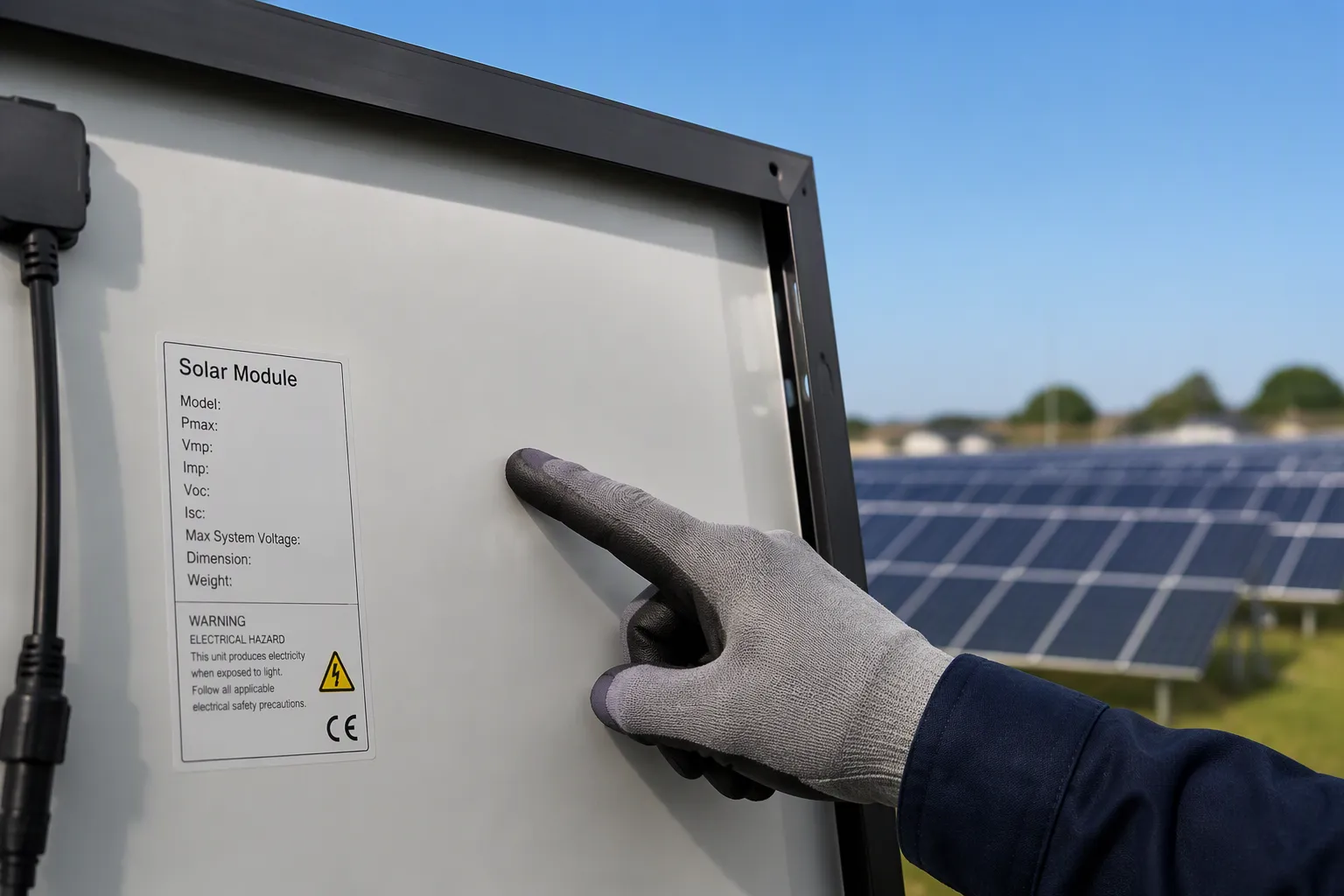
A PV backsheet film is the plastic protective layer on the rear side of a solar module. Manufacturers build it from polymer materials, often fluoropolymers or polyester-based films, and laminate it in multiple layers. Its main job is to shield the solar cells inside the panel from the outside world. This thin outer layer matters more than its size suggests. It insulates the module electrically, so people and equipment stay safe. It blocks moisture, dust, and sunlight damage. It also helps the panel keep producing power for decades. When a backsheet fails, an entire panel can stop working and raise safety concerns for the whole system.
Key Takeaways
A PV backsheet film is the protective plastic layer on the back of a solar panel.
It insulates live circuits to keep people and equipment safe.
It blocks moisture, dust, and sunlight from damaging the solar cells.
The film is made of multiple layers, often using fluoropolymers and polyester.
It helps the solar panel last for 25 years or more.
You can find backsheet films on rooftop solar, solar farms, and even flexible solar panels.
Good backsheet films resist UV light, heat, and water vapor.
When buying solar panels, check for quality tests and certifications on the backsheet.
What Is a PV Backsheet Film?
A Simple Definition
A PV backsheet film is a plastic film that serves as the rear protective layer of a photovoltaic module.
The outermost protective layer
This film forms the visible back face of a solar panel. It sits on the outside of the module, so it meets rain, dust, heat, and sunlight directly. The film must stay intact for the whole service life of the panel. A crack or a worn patch opens a path for water and current, and both can damage the module.
Positioned behind the solar cells
The backsheet sits behind the cell string, on the side facing away from the sun. The cells face the front glass. The backsheet closes the package from behind. It works with the front glass and the encapsulant to seal the cells inside a single laminated unit.
What It Is Made Of
Common polymer materials
Two polymer families dominate backsheet construction: fluoropolymer films and PET-based (polyester) films. The main fluoropolymers are PVDF (polyvinylidene fluoride) and PVF (polyvinyl fluoride). PVDF carries two fluorine atoms in each repeating unit, and its carbon–fluorine bonds give it high thermal stability, chemical resistance, and resistance to oxidation. PVF serves as a resilient external layer with strong environmental resistance. PET, or polyethylene terephthalate, is a thermoplastic polyester. It offers good mechanical behavior and cost efficiency, but it resists the outdoor environment less well than fluoropolymers when used as an external layer. PET is also vulnerable to hydrolysis once it is both hot and wet: the reaction breaks polymer chains and weakens mechanical and electrical properties. That is why damp-heat qualification at 85 °C and 85 %RH is such a demanding test for a PET core, and why hydrolysis-stabilized grades exist. Backsheets are multilayer laminates of polymeric materials with inorganic modifiers, and this mix lets suppliers tune the film to the module design.
Multi-layer laminate structure
A typical laminate pairs a thin fluoropolymer outer layer of 30–50 microns with a PET core of 200–250 microns and an inner adhesive layer of 30–50 microns. Total thickness lands at 250–300 microns. The film bonds to the encapsulant, usually EVA or POE, and the cell string under heat and pressure. Surface treatments such as corona or plasma raise the surface energy of the film and strengthen that bond.
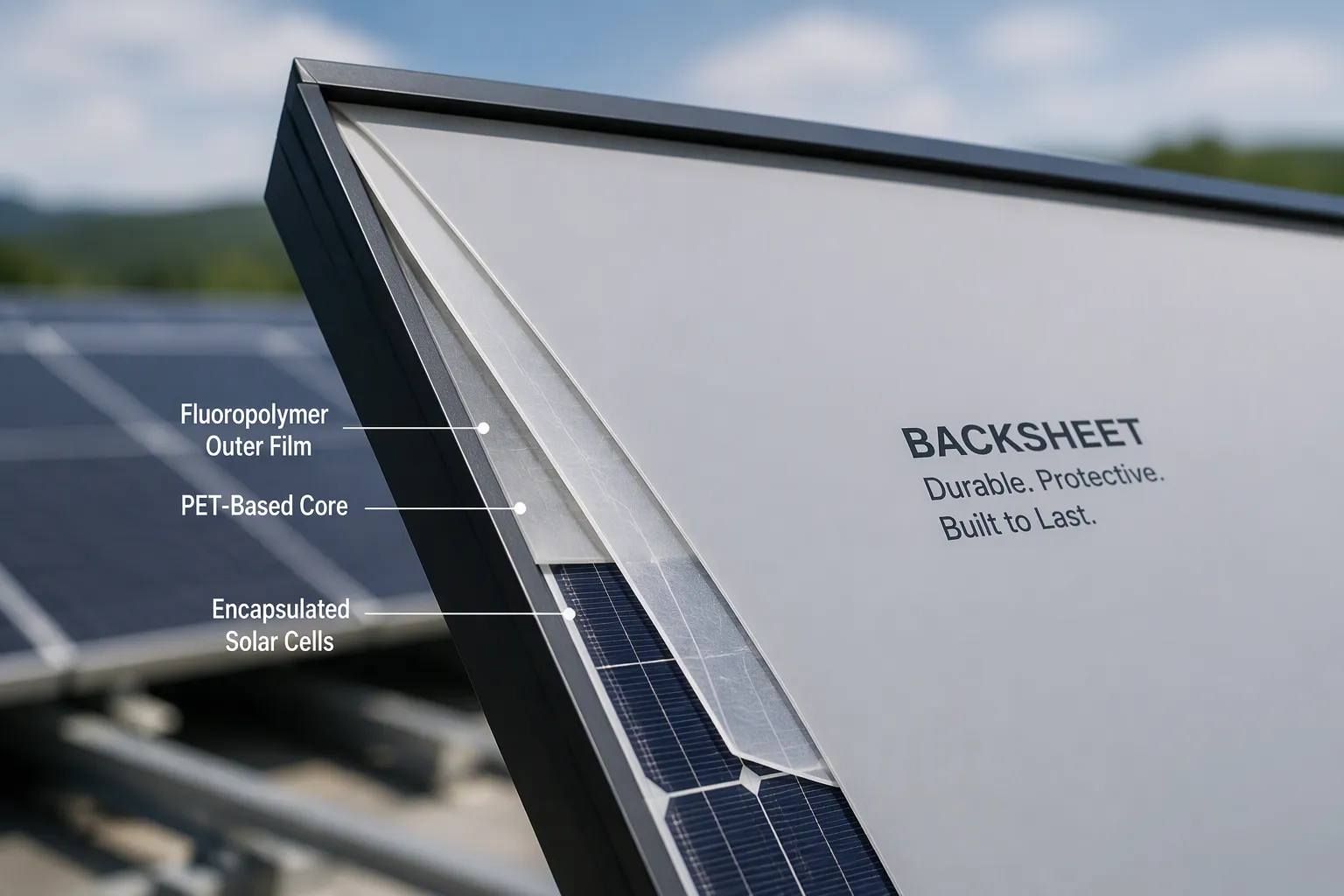
The backsheet is a multilayer laminate made from various polymer materials and inorganic modifiers. This multilayer structure allows the backsheet's optical, thermomechanical, electrical, and barrier properties to be tailored to the specific requirements of the photovoltaic module.
| Layer | Material | Function | Typical thickness |
|---|---|---|---|
| Outer | Fluoropolymer (PVDF or PVF) | UV and weather resistance | 30–50 microns |
| Core | Polyester (PET) | Mechanical strength and dimensional stability | 200–250 microns |
| Inner | EVA-compatible adhesive film | Bonding to the encapsulant | 30–50 microns |
How It Differs from Other Layers
Backsheet vs. encapsulant vs. front glass
Each layer of a module does a distinct job. The front glass faces the sun, lets light through, and carries mechanical loads from wind and snow. The encapsulant, a clear EVA or POE sheet, wraps the cells and holds them in place. The backsheet closes the rear of the package and provides electrical insulation and weather protection. The three layers also differ in appearance and placement. Glass is rigid and transparent. The encapsulant is clear and sits inside the laminate. The backsheet is opaque in most designs and forms the outer rear surface.
The laminate must balance three properties over a service life of more than 25 years: weather resistance, mechanical strength, and adhesion. Each layer contributes to that balance. The outer fluoropolymer resists UV degradation and moisture absorption. The PET core supplies the mechanical backbone and acts as a moisture barrier; solar-grade PET is commonly specified at 120–195 MPa tensile strength, depending on thickness and formulation. The inner layer secures adhesion to the encapsulant. Well-formulated laminates pair a PET core rated at 60–130 kV/mm electrical strength with a water vapor transmission rate of 1.6–3.5 g/m²·24h on the same datasheet. Thermal conductivity falls in the 0.18–0.35 W/m·K range, which helps the module shed heat while keeping insulation intact. These figures show why the rear film is an engineered structure, not a simple sheet of plastic.
What Does a PV Backsheet Film Do?
Electrical Insulation and Safety
Protecting people and equipment
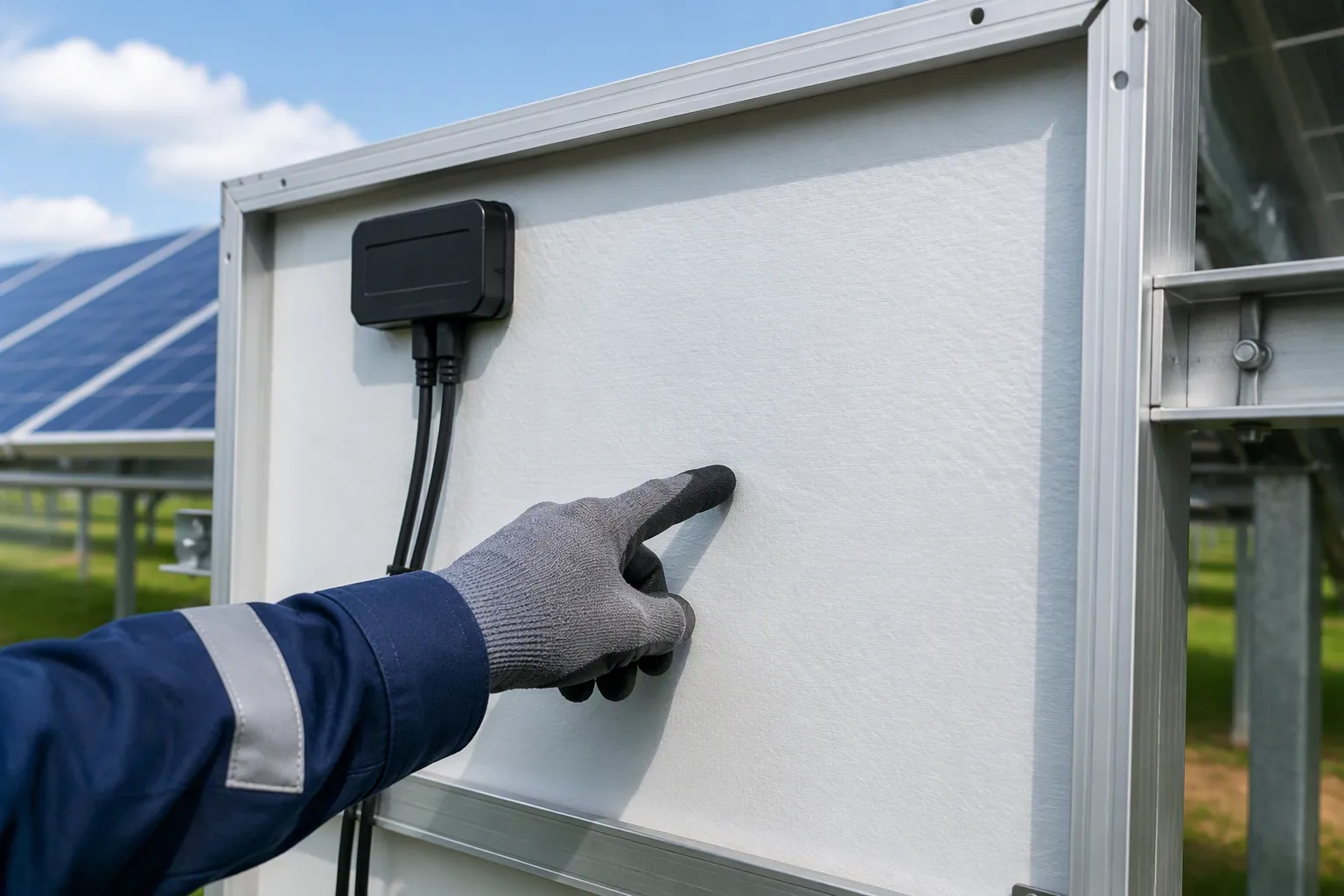
The backsheet acts as the electrical insulation between live circuits and the outside world. Solar modules often operate at system voltages up to 1500 VDC, and the rear film must hold that voltage back for decades. It stops current from leaking to the module frame and the mounting structure. That barrier protects installers, maintenance crews, and anyone who walks near an array. A sound pv backsheet film also resists partial discharge, the small electrical sparks that can eat through insulation under high voltage stress. Qualification standards such as IEC 61215 and IEC 61730 test these safety properties: IEC 61215 replaced the older IEC 61646 design-qualification standard, and UL 61730 has taken over from UL 1703 for module safety. Many products also carry TÜV or VDE certification for partial discharge testing and UL 746C recognition as polymeric materials for electrical equipment. In a typical three-layer build, the PET core of 200–250 microns carries the main insulation duty, while the outer layer handles weather and UV.
Backsheet types are usually named after their layer stack, and the stack decides which environment a module suits.
| Type | Typical construction | Rear-face appearance | Where it is commonly specified |
|---|---|---|---|
| TPT | PVF film / PET core / PVF film | Opaque white | The classic three-ply laminate for utility and rooftop modules |
| KPK | PVDF film / PET core / PVDF film | Opaque white | Coastal and high-UV sites where chemical resistance matters most |
| Coated (CPC) | Fluoropolymer coating on a PET core | White, thin | Mainstream mono-facial modules where weight and cost matter |
| Transparent | UV-stabilized clear PET layers | Clear | Bifacial modules that need rear-side light transmission |
Environmental Protection
Shielding against moisture, dust, and stress
The rear film blocks water vapor, dust, and ultraviolet light from reaching the cells and connectors. Moisture ingress corrodes electrical connections, degrades insulation, and raises short-circuit risk. Dust buildup on internal surfaces can cut efficiency. UV radiation attacks the semiconductor materials and the polymer layers themselves. White backsheets yellow under UV exposure, and that color shift signals ongoing degradation that can advance to delamination, embrittlement, or cracking. Moisture and UV often work together: UV starts surface cracks, and water deepens the damage and lowers fracture toughness. Fluoropolymer outer layers resist UV aging well, while PET outer layers degrade more readily and develop surface cracks. Adhesive layers inside the laminate suffer disproportionately from UV damage, which is one reason coextruded designs remove those adhesive layers entirely.
Supporting Long-Term Performance
Maintaining output and structural integrity
The backsheet gives the laminate its mechanical backbone. It holds the package flat, resists thermal shrinkage, and keeps the cells and wiring in place through wind, snow, and temperature swings. A low water vapor transmission rate limits moisture ingress and lowers the risk of potential-induced degradation. Conventional multi-layer backsheets show a WVTR of roughly 0.5–5 g/m²/day depending on composition and thickness. That figure looks small, yet it still exceeds glass by a wide margin, and the bond line between backsheet and encapsulant creates extra paths for moisture-driven delamination. Field surveys of glass–backsheet modules in hot, humid regions report cracking, delamination, and insulation failures well inside the 25-year design life. A well-built rear film keeps output stable and the structure intact across hot, cold, coastal, and desert climates.
Need a base film that survives damp heat and UV?
Send the required thickness, width, and the module qualification you are targeting. YUXING will confirm the grade, the hydrolysis data, and the delivery schedule.
Contact UsWhere Is PV Backsheet Film Used?
Rooftop Solar Systems
Residential and commercial installations
Rooftop arrays put the backsheet close to people, buildings, and property. Homeowners see the rear face of each panel from the ground, and building occupants live directly beneath the array. The film must insulate live circuits safely at system voltages that commonly reach 1500 VDC. It must also resist the heat that builds up under a roof-mounted panel on a summer afternoon.
Commercial rooftops add scale and complexity. Warehouses and factories often carry hundreds of modules across a single roof, and maintenance crews walk among them for inspections and cleaning. A backsheet film that cracks or delaminates exposes those workers to electrical risk. Building codes and fire standards also apply here, so module makers select rear films that pass the relevant safety tests. Weight matters too. A thin polymer backsheet keeps the laminate light, and that lower weight reduces structural load on residential and commercial roofs alike.
Utility-Scale Solar Farms
Large ground-mounted arrays
Solar farms spread modules across open land, and those sites expose panels to the full range of weather. Desert arrays face intense UV and daily temperature swings. Coastal farms meet salt spray and high humidity. Northern installations endure snow loads and hard freezes. The backsheet must hold its insulation and mechanical strength through all of these conditions for a service life beyond 25 years.
Ground-mounted arrays also run at high system voltages to cut wiring losses across long distances. That design choice raises the electrical stress on every rear film in the field. A single failed backsheet can trip a string and take many panels offline. Field replacement is costly on a remote site, so developers favor rear films with proven hydrolysis and UV resistance. Large arrays also cover wide areas, and the backsheet's white or reflective surface helps shed heat and keep module temperatures in check.
Emerging Applications
Building-integrated and flexible modules
Building-integrated photovoltaics (BIPV) turn the module into a building material. Panels serve as roofing, facades, or skylights, and the rear film often stays visible from inside the structure. Designers therefore ask for backsheets with controlled appearance, consistent color, and reliable insulation behind a thin profile. Flexible solar cells and thin-film modules bend the rules further. These designs need thin, lightweight rear films that survive repeated flexing without cracking, and high-clarity grades support modules that collect light from both faces.
Backsheet films also appear in wind turbines and electric vehicles, two adjacent renewable-energy uses. Turbine blades and nacelles house sensors and electrical parts that need weatherproof insulation. Electric vehicle roofs and body panels can carry solar cells, and those curved surfaces demand the same flexible film technology. These applications remain smaller than solar, yet they show how far the material's protective role now reaches.
What Are the Advantages of PV Backsheet Film?
UV and Weather Resistance
Withstanding sunlight, heat, and temperature swings
Sunlight breaks down polymers over time. Ultraviolet radiation attacks the chemical bonds in a film, and the damage shows up as yellowing, surface cracking, and embrittlement. A quality rear film blocks most of that radiation before it reaches the cells. Some grades achieve 99.5–99.6% UV blocking, so they act as a reliable UV protective base with strong light shading. That barrier protects the semiconductor materials inside and slows the aging of the polymer layers themselves.
Heat and temperature swings add a second stress. A panel heats up under full sun and cools at night, and the film expands and contracts with each cycle. A well-made pv backsheet film holds its shape through these cycles and keeps its mechanical properties. Low heat shrinkage supports that stability, with typical values of 1.5% or less in the machine direction and 1.0% or less in the transverse direction. Fluoropolymer outer layers resist UV aging well. PET-based backsheets rely on hydrolysis-resistant grades in hot, humid climates. Each approach fits a different set of needs.
Moisture and Dust Barrier
Keeping water vapor away from cells
Water vapor is a quiet threat to a solar module. It seeps through polymer layers, reaches the electrical connections, and starts corrosion. It also weakens the bond between the backsheet and the encapsulant, and that bond failure opens the door to delamination. A good rear film slows this process with a low water vapor transmission rate. Hydrolysis testing measures how well a film holds up under damp heat. Films that pass a rigorous PCT 60-hour hydrolysis test keep their physical stability against extreme moisture and heat.
Dust protection works alongside the moisture barrier. The film seals the rear of the laminate, so dust and grit cannot reach the cells or the wiring. This seal matters most in coastal sites, tropical regions, and dusty desert farms, where moisture and particles attack the module from every side. A film with a low yellowing rate and strong UV blocking keeps its barrier function intact for decades of outdoor exposure.
Durability and Long Life
Contributing to decades of reliable operation
Solar developers expect a module to work for 25 years or more. The rear film must withstand that full span of environmental exposure and keep functioning under extreme weather. Design targets reflect this: backsheets are built for a service life beyond 25 years, with strong aging and weathering resistance. That long life lowers the long-term cost of ownership, because fewer panels need replacement and maintenance visits drop.
Durability also supports electrical safety. A film that resists yellowing, embrittlement, and mechanical property loss keeps its dielectric strength in heat, rain, and humidity. Comparative aging studies report a higher breakdown voltage and better abrasion resistance for PVDF than for PVF, with similar yellowing and mechanical retention. Both materials serve the same goal: a rear layer that insulates live circuits safely for the whole life of the array.
How Does YUXING Support PV Backsheet Film Production?
Jiangsu Yuxing Film Technology Co., Ltd. has manufactured BOPET film since 2004. The company runs 13 production lines and holds an annual capacity of 250,000 tons. A CNAS-accredited laboratory supports its testing work, and its products comply with RoHS and REACH standards. This background gives module makers a stable source of base films for rear-side protection. Yuxing supplies these films as roll stock for coating and lamination.
BOPET Films for Backsheets
Core layer and outer layer films
YUXING supplies solar-grade BOPET films for two main roles in a backsheet laminate. Core layer films provide structural support and carry the mechanical load of the module. Functional outer layer films add weather resistance at the exposed rear face. The company also offers high-clarity films for flexible solar cells and thin-film modules. These grades share the same precision thickness control and dielectric expertise found in the company's BOPET Films for High-Voltage Insulation & Motors, a UL-certified electrical insulation portfolio. That shared manufacturing base helps keep film quality consistent across product lines.


Key Film Properties
Hydrolysis and UV resistance
Moisture and sunlight are the two forces that age a pv backsheet film fastest. YUXING's hydrolysis-resistant grades limit mechanical property loss in hot, humid conditions. UV-resistant grades support long-term outdoor exposure. Both properties help the film hold its strength and barrier function through years of service.
Dimensional stability and insulation
A backsheet must stay flat as module temperatures rise and fall. YUXING films offer low thermal shrinkage, which reduces the risk of module warping over time. Reliable electrical insulation keeps dielectric performance intact under system voltage. These traits support both the mechanical and the safety sides of module design.
Quality and Customization
CNAS lab, RoHS and REACH compliance
The CNAS-accredited laboratory lets YUXING test film properties in-house and share technical data with customers. RoHS and REACH compliance confirms the films meet international environmental requirements. Buyers can request customization of thickness, width, surface treatment, and packaging to match their production lines. YUXING also provides sample rolls and support for coating and backsheet lamination validation, so customers can confirm fit before full-scale runs.
Compare grades before you commit to a lamination trial
Sample rolls, datasheets, and PCT / damp-heat results are available on request. Tell us the laminate stack and we will match the base film to it.
Contact UsWhat Is the Future of PV Backsheet Film?
Material and Design Trends
Thinner, lighter, more efficient films
Backsheet design is moving toward thinner, lighter structures. Demand for thin-film modules in building-integrated photovoltaics and portable power pushes rear films to deliver robust protection without excess weight or rigidity. Several related trends shape this shift:
Flexible, lightweight constructions that accommodate curved shapes and mechanical stress
Multilayer polymer composites (PET, PVDF, PEN) that improve UV, moisture, and insulation resistance
Transparent grades for bifacial modules, which boost rear-side light capture and energy yield
Fluorine-free, recyclable, and bio-based materials that reduce lifecycle environmental impact
Fire-resistant grades for rooftop and building-integrated applications
Heat-reflective coating technologies that help modules run cooler
Regional subsidies, especially in Asia Pacific, support research into ultra-thin, high-performance solar backsheets. Fluoropolymer-based materials remain popular for their UV resistance and weatherability across a 25-year service life.
Growth in Renewable Energy
Role in the clean energy transition
Solar deployment keeps expanding, and every new module needs a rear protective layer. Annual installations have grown at a double-digit pace in most years of the past decade, and each new gigawatt brings demand for backsheet film with it. Supportive policies such as tax credits, rebates, and feed-in tariffs lower installation costs and stimulate further demand.
Diversification adds momentum. Solar now appears in automotive, agricultural, and building-integrated applications, and each use calls for backsheets tuned to flexible or lightweight formats. Regions with high solar insolation and aggressive renewable targets, including North America, Europe, China, and India, drive demand for high-performance rear films. Coastal and desert projects raise the bar on weather resistance. As decarbonization spreads to emerging markets, suppliers gain new opportunities.
What Buyers Should Check
Quality checks when sourcing
Sourcing decisions should rest on test data, not appearance. Buyers should request UV aging results showing retained tensile strength and low yellowing, plus damp-heat data at 85 °C and 85 %RH over thousands of hours to support a 25-year service life. Lamination compatibility data, dielectric strength figures, and batch-level traceability from resin lot to laminate roll all matter. Formal compliance with IEC 61215 and IEC 61730 is expected, alongside valid TÜV and UL 746C reports and ISO 9001 certification for the manufacturer. Uncertified imitation films warrant caution.
Fire classification for transparent and lightweight backsheet constructions is the usual certification bottleneck; regional building code variance means separate approvals are needed for EU, U.S., and Japanese rooftop applications. Extended sequential testing beyond baseline requirements, dual-sourcing across two chemistries, and small pre-production trial runs help confirm batch consistency.
A pv backsheet film is the rear protective layer of a solar module, and it carries three jobs at once: it insulates live circuits, it blocks moisture, dust, and sunlight, and it holds the laminate together. Those jobs decide whether a panel stays safe and keeps producing power for decades. The same material will keep serving the clean energy transition as solar spreads into new formats and new markets.
Sourcing solar-grade BOPET base film?
YUXING supplies white, UV-resistant and hydrolysis-resistant PET film from 50 to 300 microns, with CNAS in-house testing and RoHS / REACH compliance.
Contact UsFAQ
What thickness does a PV backsheet film usually have?
Most laminates land between 250 and 300 microns in total. A typical build pairs a 30–50 micron fluoropolymer outer layer with a 200–250 micron PET core and a 30–50 micron adhesive layer. Module designers adjust these figures to match their mechanical and insulation targets.
Which materials make up a PV backsheet film?
Two polymer families dominate the market: fluoropolymers such as PVDF and PVF, and PET-based polyester films. Suppliers blend these polymers with inorganic modifiers in a multilayer laminate. Each layer contributes a different property, from UV resistance at the outer face to mechanical strength in the core.
Why does electrical insulation matter so much in this film?
Solar modules often run at system voltages up to 1500 VDC. The rear film holds that voltage back from the frame and mounting structure. It also resists partial discharge under high voltage stress. Standards such as IEC 61730 and UL 61730 test these safety properties.
How long does a PV backsheet film last?
Developers design backsheets for a service life beyond 25 years. The film must resist UV exposure, moisture, and temperature cycling across that span. Field experience shows weak rear films can fail well before that target in humid regions, which raises replacement costs and safety concerns.
Does climate affect which backsheet grade a buyer should pick?
Yes. Fluoropolymer outer layers resist UV aging well and suit intense sun. PET-based backsheets rely on hydrolysis-resistant grades in hot, humid climates. Both approaches fit different needs, so the operating environment should guide the choice rather than a single universal answer.
What tests should buyers request before ordering?
Buyers should ask for UV aging data, damp-heat results at 85 °C and 85 %RH, dielectric strength figures, and lamination compatibility reports. Batch traceability and compliance with IEC 61215 and IEC 61730 also matter. Sample rolls let teams validate performance before full-scale production.
Can a PV backsheet film serve applications beyond solar panels?
Yes. The same protective films appear in wind turbines and electric vehicles, where sensors and electrical parts need weatherproof insulation. Building-integrated photovoltaics and flexible thin-film modules also use thin, lightweight rear films. These uses remain smaller than solar but continue to expand.
Where can buyers source a reliable PV backsheet film?
YUXING supplies solar-grade BOPET base films for backsheet laminates. Jiangsu Yuxing Film Technology Co., Ltd. has manufactured BOPET film since 2004, runs 13 production lines with 250,000 tons of annual capacity, and tests in a CNAS-accredited laboratory. Its films comply with RoHS and REACH standards.
Sources
1. IEA Photovoltaic Power Systems Programme, Task 13 — Performance, Operation and Reliability of Photovoltaic Systems. iea-pvps.org
2. U.S. Department of Energy, Office of Energy Efficiency & Renewable Energy — Photovoltaics. energy.gov
3. Oreski, G. et al. Lifetime Evaluation of Photovoltaic Polymeric Backsheets under Ultraviolet Radiation. ACS Omega, 2022. pmc.ncbi.nlm.nih.gov
4. Andrady, A. L. et al. Effects of UV radiation on natural and synthetic materials. Photochemical & Photobiological Sciences, 2023. pmc.ncbi.nlm.nih.gov
5. Product data, YUXING: CY11, CY11NS and CY25HTG48 solar backsheet base films — thickness range, tensile strength, heat shrinkage, WVTR, electrical strength and UV isolation rate. bopet-film-china.com