


What Is PET Base Film? Definition, Composition, and Key Properties
PET base film is a thin sheet of polyethylene terephthalate resin used as the foundation layer that coatings, adhesives, and metal layers are built on, chosen for its strength, dimensional stability, heat resistance, and optical clarity.
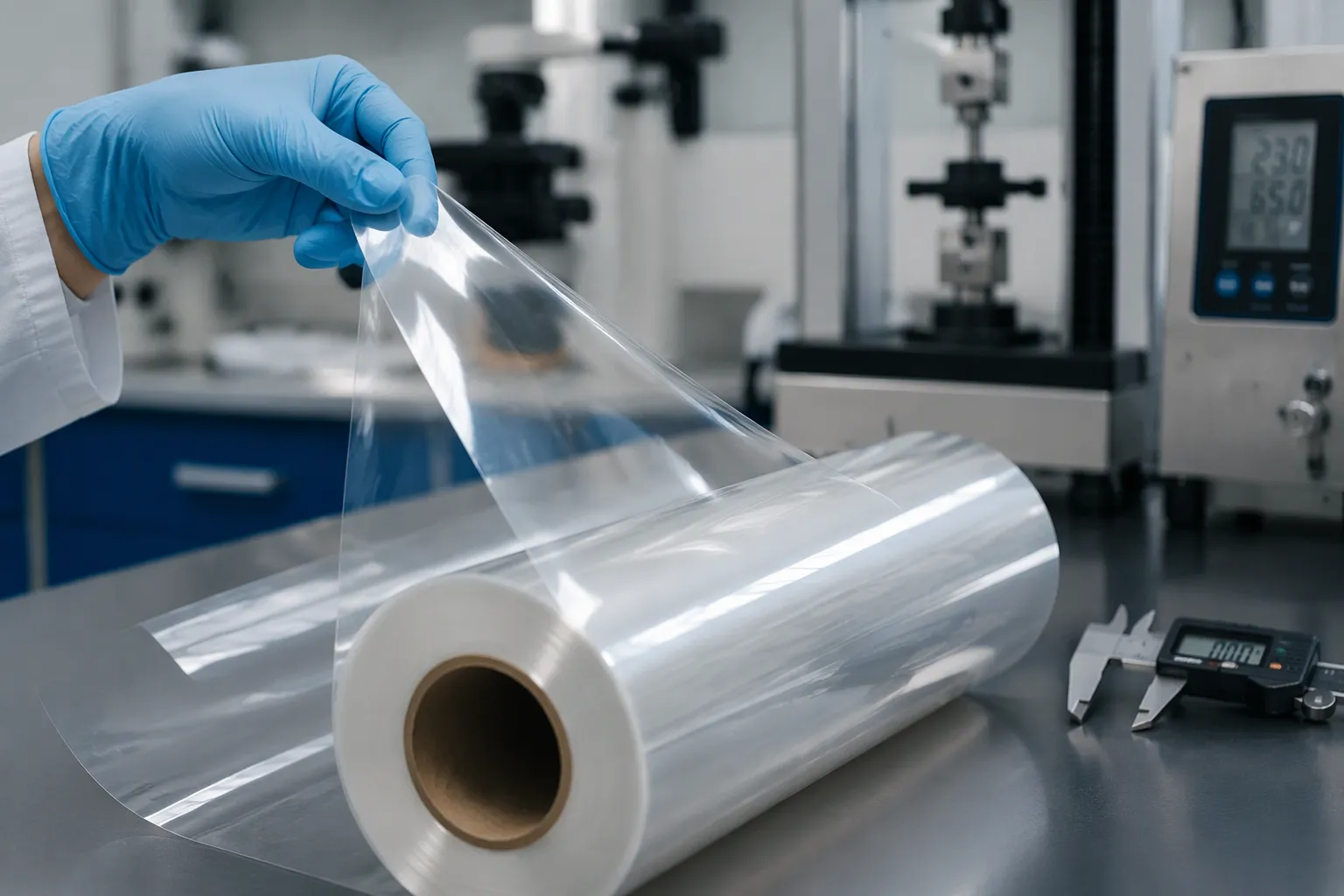
PET base film is a thin plastic sheet made from polyethylene terephthalate, a common polyester resin. This article explains what it is made of and its key properties. Think of it as a strong, clear film that keeps its shape and serves as a base layer, much like the sturdy backing beneath a sticker or a coat of paint. Manufacturers build other layers on top of this base. The film holds those layers flat, protects them, and keeps the final product reliable. It resists stretching and heat during processing, so later steps stay consistent. That combination makes the material a practical starting point for many industrial products.
Key Takeaways
PET base film is a strong, clear plastic sheet made from polyethylene terephthalate resin.
It acts as a base layer for coatings, adhesives, and other materials, and compares with other film bases on stability, heat resistance, and cost.
Stretching the film in two directions lines up the polymer chains and makes it stronger and more stable.
Key properties include high tensile strength, heat resistance, and optical clarity.
Additives and coatings adjust surface properties such as slip and barrier.
PET film is used for packaging, electronics, and industrial applications, and the grade chosen decides which of those duties it can carry.
Pick the grade and thickness to match the process the film will run through.
Check certificates and data sheets against the requirements of the end use before the first order.
PET Base Film Defined
A Simple Definition
What "PET" Stands For
PET stands for polyethylene terephthalate. This resin is part of the polyester family and is the most widely used thermoplastic polyester in commercial production. Manufacturers polymerize it from ethylene glycol and terephthalic acid, then form it into pellets. Those pellets become the raw material for every PET film sold today.
People often ask about the difference between PET film and BOPET film. Both start from the same polyester resin, but they are not identical products: the BOPET label means the cast sheet went through biaxial stretching, which changes its physical behaviour. Whether BOPET and plain PET behave the same way depends on that stretching step and on the heat-setting that follows it. In sourcing practice, PET film and polyester film name the same product family, while BOPET names the oriented version of it.
Why "Base Film" Matters
The word "base" describes the film's job. It acts as a foundation layer. Other coatings, adhesives, or metal layers sit on top of it. The base film supplies strength, flatness, and heat resistance during those later steps. A weak foundation would distort under coating heat or tension. A stable one keeps every added layer aligned.
How PET Film Is Made
From Resin Pellets to Thin Film
Production starts with dried resin pellets. Extruders melt the pellets and push the melt through a slot die onto a chilled drum. The melt hardens into a thick, amorphous sheet. This cast sheet then moves to the stretching line, where heat and rollers turn it into thin films with consistent gauge.
Biaxial Orientation Explained
The biaxial orientation process stretches the sheet in two directions. Machine-direction rollers pull it forward. A tenter frame grips the edges and pulls it sideways. Polymer chains line up along both axes, and the film gains strength and dimensional stability. Commercial base film for carrier uses commonly ranges from about 12 to 36 microns. Industrial grades of BOPET film can run from 36 to 500 microns, and current supplier catalogues extend well beyond that at both ends, from roughly 23 microns up to 600 microns for heavy insulation grades.
How It Differs from Other Plastic Films
Each film base fits a different job. BOPP offers low cost and good moisture protection, which suits snack packaging. PVC brings softness and easy heat sealing, which helps shrink sleeves and labels. PET film is usually the choice where clarity, strength, and heat resistance matter together. Optical grades stay clear at high temperatures, and mechanical grades hold their shape under tension. A buyer who needs all three properties in one film usually finds PET the practical option.
Chemical Composition and Structure
The PET Polymer
Chemistry in Plain Terms
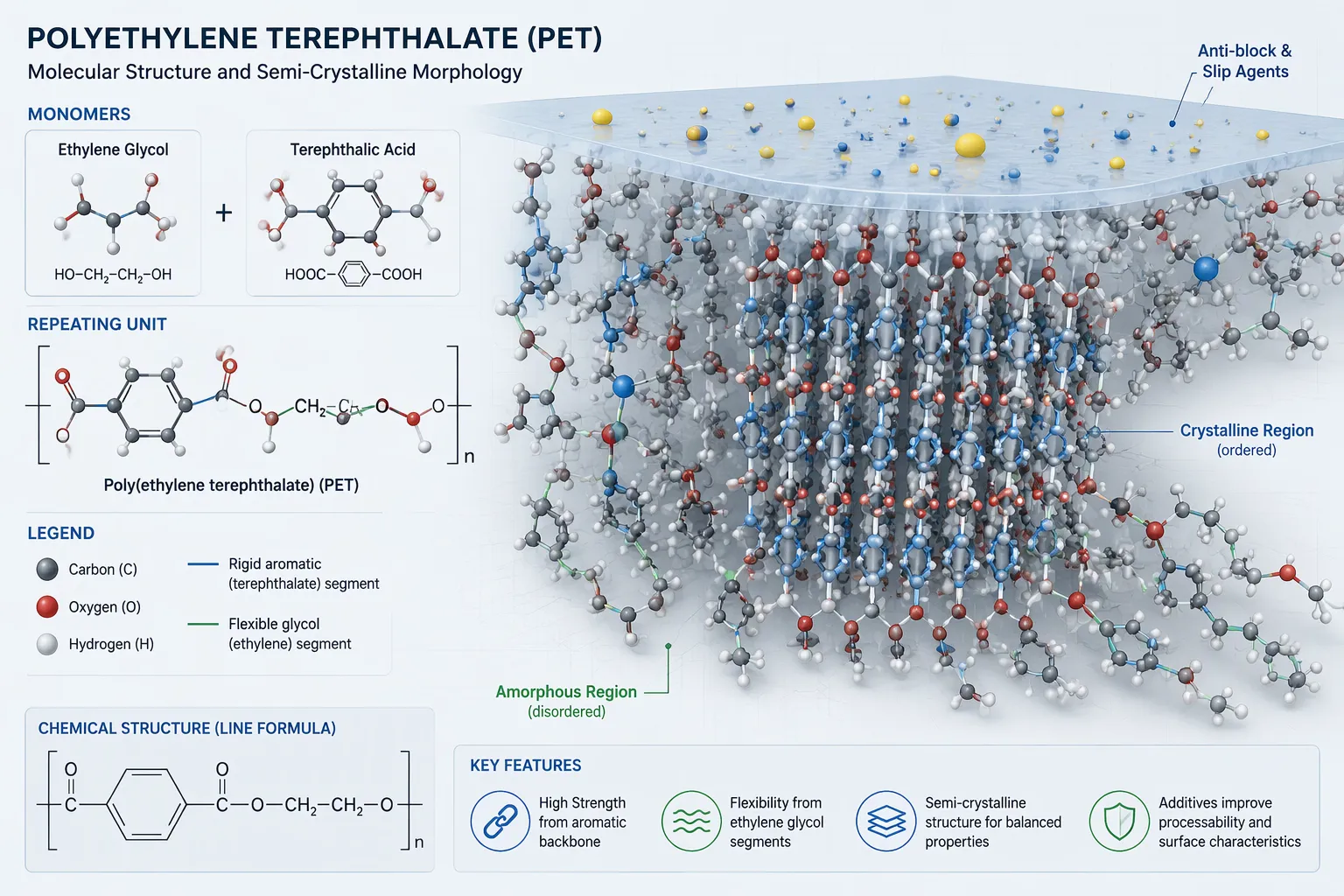
Polyethylene terephthalate is part of the polyester family. Two monomers make up the chain: ethylene glycol and terephthalic acid. A condensation reaction joins them, and water leaves as a byproduct. The result is a long-chain polymer with repeating ester units. In its natural state, this resin is a colorless, semi-crystalline thermoplastic polymer. It feels hard and stiff, and it holds its shape well under load. Those traits carry straight into the finished film.
The composition matters because every property of the final sheet comes back to this chain. A polyester film gets its stiffness from the aromatic rings in its backbone. It gets its toughness from the way those chains pack together. The chemistry sets that baseline; orientation and additive choices build on it rather than replace it.
Chain Structure and Performance
The polymer chains have rigid aromatic segments and flexible glycol segments. This mix gives PET its two-sided nature. The rigid parts resist deformation. The flexible parts absorb impact without cracking. Heat and stretching arrange the chains into ordered regions, and those regions sit next to disordered ones. That mixed arrangement defines a semi-crystalline structure.
Chain length also shapes performance. Longer chains tangle more, and the film resists flow at high temperature. The biaxial orientation process then lines up the chains in the plane of the sheet. Alignment boosts tensile strength along both axes. It also locks in dimensional stability, so the film resists shrinkage during coating and lamination.
Additives and Surface Treatments
Common Additives and Their Roles
Pure resin rarely ships as-is. Manufacturers add small amounts of helper materials, and each one solves a specific handling problem.
Anti-block agents create tiny surface asperities. These bumps stop nearby film layers from sticking when the roll unwinds.
Slip additives lower the coefficient of friction. They help the web move smoothly over rollers and guides.
UV stabilizers absorb or screen ultraviolet energy. They slow yellowing and chain scission in outdoor service.
Inorganic particles, such as silica, tune surface roughness. Roughness controls gloss and haze in optical grades.
Each additive stays at a low loading level. Too much would cloud the film or weaken it. Formulators balance these effects against the clarity and strength that buyers expect.
Primer and Coating Layers
Surface treatments change how the film acts at its interface. A primer layer is a thin chemical bridge. It bonds the base sheet to later coatings, inks, or adhesives. Without it, a metallized layer might flake, and a printed image might lift.
Functional coatings go further. A hard coat resists scratching on display surfaces. A barrier coating blocks oxygen or moisture for sensitive contents. Conductive coatings support touch sensors and electrodes. Each treatment targets one job, and the underlying sheet still carries the mechanical load. This division of labor keeps the design flexible.
How Structure Connects to Properties
Structure and performance form a direct chain of cause and effect. The aromatic backbone delivers stiffness and heat resistance. Chain alignment from stretching delivers tensile strength and dimensional stability. Crystallinity controls how the film responds to heat, including its shrinkage behavior. Additives adjust friction, blocking, and weatherability without touching the core chemistry. Coatings add barrier, adhesion, or hardness at the surface.
A reader can use this model to predict behavior. Need more stiffness? Choose a thicker gauge or a higher-intrinsic-viscosity resin. Need better slip? Ask for a slip-modified grade. Need a barrier? Add a coating rather than change the polymer. The composition stays constant across most grades of PET film. The additives and treatments do the tailoring. That is why one base chemistry serves packaging, electronics, and insulation at once. Understanding the structure gives a buyer a reliable way to compare PET film and polyester film data sheets, because both describe the same polymer with different finishing choices.
Key Properties of PET Film
The key properties of PET film fall into five groups: mechanical, thermal, optical, barrier, and electrical. Each group comes back to the polymer chain and the stretching step described earlier. This section explains what each group means in real use, and how the range of PET film applications follows from those groups.
| Property group | Typical published value | Common test method |
|---|---|---|
| Mechanical | Tensile strength 145 to 190 MPa for electrical grades; 200 to 260 MPa quoted for general BOPET | ASTM D882, GB/T 13542.2 |
| Thermal | Melting point 255 to 260 °C; shrinkage about 1.0 to 1.3 percent MD at 150 °C for 30 minutes | GB/T 13542.2 |
| Optical | Light transmittance 87.5 to 90 percent; haze about 1 to 5 percent depending on grade | ASTM D1003, GB/T 2410 |
| Barrier | Plain film around 20 to 30 g/m²/day water vapor transmission; coated and metallized grades far lower | ASTM F1249, GB/T 21529 |
| Electrical | Electrical strength roughly 50 to 174 V/μm across the gauge range; permittivity 2.9 to 3.4 at 50 Hz | GB/T 1408.1, ASTM D150 |

Mechanical Properties
Tensile Strength and Stiffness
Tensile strength measures how much pull a film can take before it breaks. Stiffness measures how much it resists bending. Biaxial orientation lines up the polymer chains, so both values go up together. Tensile figures are obtained with the standard test method for thin plastic sheeting, which is why data sheets normally state the direction of the test. Electrical grades of PET film are commonly rated between about 145 and 190 MPa, and general BOPET grades are often quoted at 200 to 260 MPa. That level of high mechanical strength lets thin gauges carry loads that would stretch softer films. A 36-micron sheet, for example, stays flat across a wide web without sagging between rollers.
Toughness and Tear Resistance
Toughness describes how much energy a film soaks up before it fails. Tear resistance describes how well it stops a small nick from growing into a long split. The semi-crystalline structure of PET film supports both. Ordered regions block cracks from growing, and the flexible chain segments absorb impact. A converter who slits a roll rarely sees the web run away into a tear. That behavior keeps production lines running without constant re-threading.
Dimensional Stability
Dimensional stability means the film keeps its size under heat and tension. This property matters most during coating and lamination. A stable web stays lined up with print cylinders and coating rollers. The combination of tensile strength and dimensional stability makes PET film a dependable carrier for precision processes. A film that grew or shrank between steps would throw every later layer out of alignment.
Match a Film Grade to Your Process
Send the gauge, width, and end use, and the supplier can confirm which electrical or optical grade fits the line.
Thermal and Optical Properties
Heat Resistance and Shrinkage
PET film holds its shape at temperatures that would soften many other plastic films. The melting point sits near 255 to 260 °C, well above typical drying and coating temperatures. Shrinkage stays low when the film sees moderate heat, which protects registration during oven passes. Buyers should still check the shrinkage figure on the data sheet, because it changes with grade and heat-setting history.
Clarity, Gloss, and Haze
Optical clarity sets PET film apart from most competing materials. Optical grades can reach roughly 88 to 90 percent light transmittance with haze near 1 percent, both read from the standard haze and luminous transmittance method for transparent plastics. Gloss depends on surface roughness, and formulators tune it with inorganic particles. A smooth surface gives high gloss for display use. A roughened surface scatters light for matte finishes. These optical properties make the film a common choice for screens, labels, and window applications.
Barrier and Electrical Properties
Moisture and Gas Barrier
Base PET film offers moderate oxygen and moisture protection. That level suits many short-life packages and general protection duties, and water vapor transmission is read with the modulated infrared sensor method for film and sheeting. Metallized or PVDC-coated variants achieve high barrier performance when shelf life or aroma retention is required. A coffee pack or a sensitive food sachet usually needs one of these enhanced versions. The base sheet supplies the strength, and the coating supplies the barrier.
Electrical Insulation
Electrical insulation is a core strength of this material, and the electrical insulation film range is built around it. Electrical strength is measured in volts per micron, the voltage a given thickness takes before breakdown. It falls as the film gets thicker: one current catalogue lists about 170 V/μm at 23 μm and about 50 V/μm at 350 μm, while general BOPET data sheets often quote 100 to 200 V/μm. The film also resists tracking and holds up under continuous thermal load. These core PET properties explain its wide use in motors, transformers, and capacitors.
Chemical Resistance
Most common solvents, oils, and acids leave the film unchanged at room temperature. Strong alkalis can attack the ester linkage over time, so formulators avoid them in contact applications. This resistance profile supports cleaning steps and protects the film in automotive and industrial settings. Together, these physical and chemical properties give designers a predictable material to specify.
The core properties of PET film therefore form one connected system. Chain chemistry sets the baseline. Orientation raises strength and stability. Additives and coatings fine-tune the surface. A buyer who understands this system can read any data sheet with confidence.
Two grades show how far the same polymer can be pushed in different directions.

6020 Universal PET Film
Transparent electrical insulation film from 23 to 350 μm, with UL recognition and good laminating processability.
View Product
CY11 Solar Backsheet Film
White polyester film for solar cell backsheets, supplied from 100 to 300 μm with heat resistance and low water vapor transmission.
View ProductApplications of PET Film
Packaging and Labeling
Packaging and labeling are among the most common uses of PET film. PET film gives labels, flexible packs, and release liners strength, clarity, and moderate barrier performance. A thin gauge of PET film holds up on high-speed labeling lines without stretching out of register. Print stays sharp because PET film takes primer and coating layers well.
Base grades provide moderate oxygen and moisture protection, which fits short-life goods and general protection duties. Metallized or coated versions raise that barrier when a product needs longer shelf life or better aroma retention. Converters also value the dimensional stability of PET film, since a stable web keeps die cuts and print steps lined up.
Electronics and Displays
Electronics and displays depend on optical clarity and dimensional stability. A display stack needs a clear substrate that stays flat through coating, drying, and lamination. Optical grades of PET film let most visible light through with low haze, so backlight units keep their brightness and contrast. These properties also support touch sensors and protective cover layers.
Electrical insulation is a second electronics role. Insulation grades of PET film resist breakdown under voltage and hold up under continuous thermal load, which suits motors, transformers, and capacitors. The key features and types of electrical insulation film run from thin capacitor grades to thick spacers, and the same polymer that carries a display layer can also separate conductive parts. That range explains why one base chemistry serves both duties.
Industrial and Specialty Uses
Industrial and specialty uses draw on the full property set. Solar backsheets need weatherability and electrical insulation. Automotive window film needs optical clarity plus resistance to ultraviolet energy, which is why a high clarity film base is specified for that stack. Medical and textile products, such as X-ray films and test strips, need a clean, stable surface. Capacitors and tapes need consistent dielectric behavior and reliable adhesion.
Each case traces back to structure. Chain alignment delivers the strength and stability these products demand. Additives and coatings add UV screening, slip, or barrier where a job requires it. A buyer who maps a requirement to a property group can shortlist the right grade quickly. BOPET film grades and standard polyester film grades share this base chemistry, and a second look at any polyester film data sheet confirms it. That habit turns a long list of uses into a simple matching exercise, and BOPET film in packaging and electronics follows the same logic.
Choosing the Right PET Base Film
Matching Grade to Application
Picking a grade starts with what the film will do, not what it costs. Optical grades work well for diffusion, reflection, and pre-coating layers in displays. Electrical grades carry UL recognition for motors and transformers. Functional industrial grades handle solar, automotive, and medical jobs. Surface appearance grades give matte or colored finishes for decoration. When a buyer names the job first, the PET film types become easy to narrow down.
Each grade steers the same polymer toward one group of properties. An optical grade focuses on light transmission and low haze. An electrical grade focuses on dielectric strength and heat resistance. A functional grade may add UV screening or barrier layers. Matching the grade to the job avoids over-specifying and keeps cost in line with need. Model codes differ between suppliers, so the product FAQ on grade codes and specifications is worth reading before two catalogues are compared line by line.
Compare Grades Before You Specify
Optical and electrical grades are listed separately, so each property set can be checked against the application.
Thickness and Format Considerations
Gauge choice follows the process, not habit. Thin gauges work for carrier and release jobs, while heavy gauges serve insulation and backsheet work. Standard PET film thickness runs from 36 to 500 microns in industrial supply. The thickness of PET film affects stiffness, barrier, and voltage withstand all at once, so changing the gauge shifts several properties together.
Width matters as much as gauge. Check the roll width against the coating line, the slitter, and the converting equipment before you order. A web wider than the machine wastes material, and a narrow roll adds splices. Check core size, roll diameter, and winding tension too. These format details decide whether a roll runs cleanly on the first pass.
Quality and Compliance Checks
Reviewing certifications protects the buyer and the project. Electrical insulation grades should carry UL recognition for the intended use. RoHS and REACH declarations confirm that the material meets restricted-substance rules in major markets. A lab accredited to CNAS shows that test reports carry independent weight. Ask for current certificates rather than older copies.
Consistency deserves equal attention. Request technical data sheets that state tensile strength, electrical strength, haze, and shrinkage for the exact grade. Compare incoming rolls against those figures with a simple check. When sourcing PET base film, a supplier with in-house testing and steady process control cuts down on surprises at the line. A short review of certificates, data sheets, and sample rolls answers most questions before the first order ships.
PET base film is a thin sheet of polyethylene terephthalate resin. It acts as a foundation for coatings, adhesives, and added layers. The composition blends polyester chemistry with small additives and surface treatments. These choices shape five property groups: mechanical, thermal, optical, barrier, and electrical. Structure drives performance at every step. Chain chemistry sets the baseline, orientation builds strength and stability, and coatings fine-tune the surface. This simple model explains why one PET film grade suits packaging while another serves insulation. The material rewards a buyer who matches grade to job, and it stays predictable once the specification is fixed in writing.
FAQ
What does PET stand for in packaging?
PET stands for polyethylene terephthalate. This polyester resin is the base material for many clear sheets. Manufacturers join ethylene glycol and terephthalic acid into long chains. Those chains give the finished sheet its strength and clarity.
Is polyester film the same as PET film?
Yes, at the resin level. Both names mean one product family. The polyester label points to the polymer family, and PET names the exact resin. BOPET then identifies the biaxially stretched version, which behaves differently from an unstretched cast sheet, so the two should not be treated as interchangeable on a specification.
What thickness does a PET base film come in?
Commercial carrier grades usually run from about 12 to 36 microns. Industrial grades of BOPET film can range from 36 to 500 microns, and heavy insulation grades reach 600 microns. The gauge changes stiffness, barrier, and voltage withstand all at once, so the job decides the thickness.
How clear is an optical grade?
Optical grades can reach roughly 88 to 90 percent light transmittance with haze near 1 percent. That clarity works well for display stacks, labels, and window applications. Surface particles adjust gloss and haze to match a matte or glossy finish.
Does PET film block moisture and oxygen?
Base grades give moderate protection, in the region of 20 to 30 g/m²/day water vapor transmission for plain film. Metallized or PVDC-coated versions raise the barrier when a product needs longer shelf life or aroma retention. The base sheet carries the strength, and the coating supplies the barrier.
Can this material insulate electrical parts?
Yes. Electrical strength is quoted between roughly 50 V/μm at heavy gauges and 170 V/μm at thin gauges, with tensile strength of 145 to 190 MPa for those grades. Many carry UL recognition for motors and transformers. The polymer resists tracking and holds up under continuous thermal load.
Why does stretching matter in BOPET production?
Biaxial stretching pulls the sheet in two directions. Polymer chains line up along both axes. That alignment builds tensile strength and dimensional stability, which keeps the web flat during coating and lamination.
How should a buyer check quality?
Ask for current certificates, not older copies. Electrical grades should show UL recognition, and RoHS and REACH declarations confirm restricted-substance rules. A CNAS-accredited lab adds independent weight to test reports.
Request Samples and Current Certificates
Samples, grade data sheets, and compliance documents can be requested together, so the specification can be checked before an order is placed.
References and Notes
Tensile properties of thin plastic sheeting — the test method behind the tensile strength and elongation figures (astm.org, accessed 2026-11-16).
Haze and luminous transmittance of transparent plastics — the optical method used for the transmittance and haze values (astm.org, accessed 2026-11-16).
Water vapor transmission rate through plastic film and sheeting — the basis for the barrier figures quoted here (astm.org, accessed 2026-11-16).
AC loss characteristics and permittivity of solid electrical insulation — supports the permittivity and dissipation factor values (astm.org, accessed 2026-11-16).
Data notes: property values in the summary table combine published catalogue figures for electrical grades with general BOPET industry ranges, and they shift with gauge, grade, and heat-setting history. Values quoted in the original article as single figures have been widened to ranges and should be confirmed on the current data sheet for the exact grade.
Figure note: the composition illustration is a schematic. The printed line formula is the reliable repeat unit; the rendered inset is illustrative only.
Internal links: all original links pointing to www.bopet-film-china.com are preserved.