


PET Base Film vs Other Film Bases A Comparative Analysis
The film base chosen for a product often affects its success as much as the design does, and PET, BOPP, PVC, PEN and paper each suit different situations.
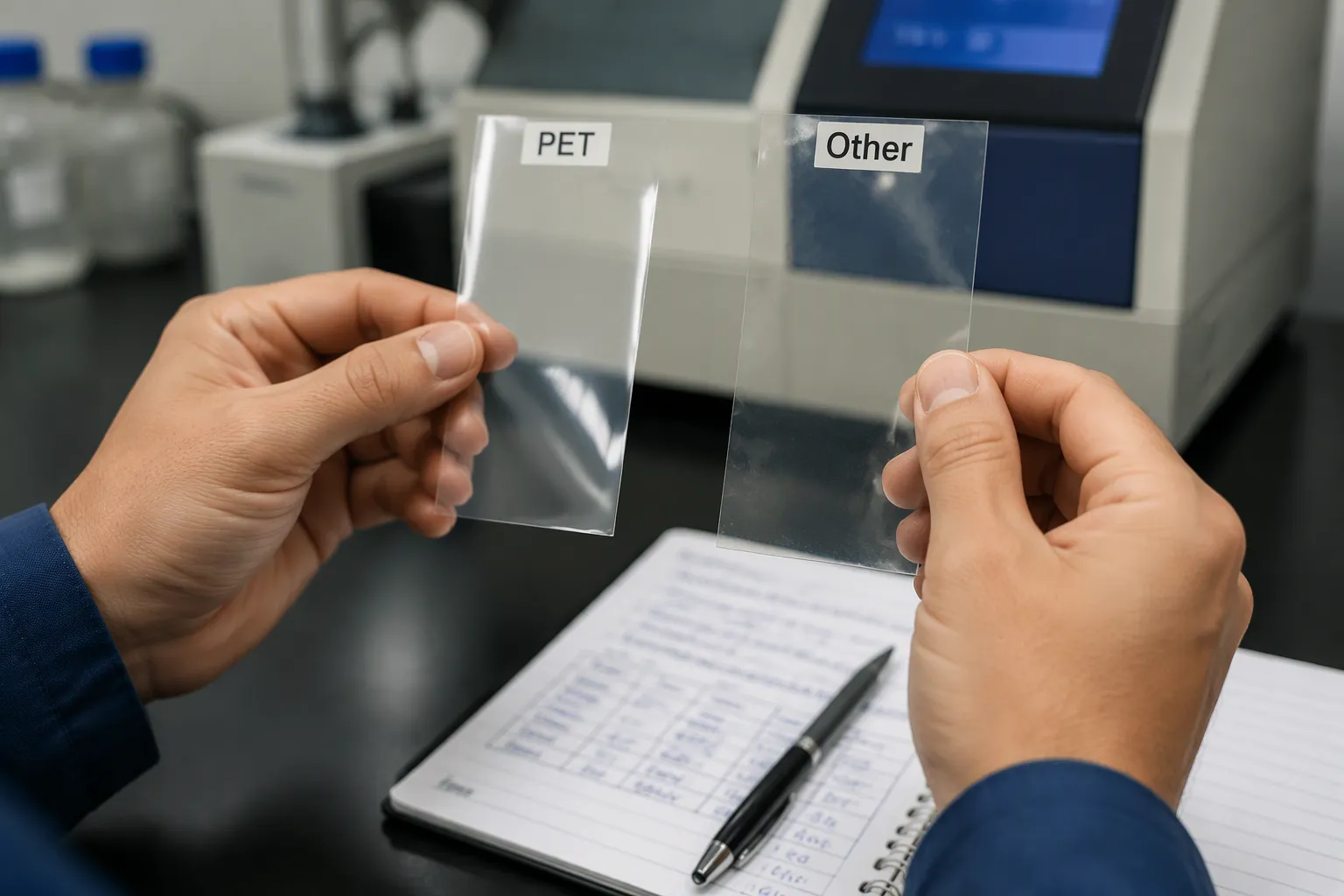
No single base fits every job. PET base film usually suits projects that need dimensional stability, heat resistance, and a balanced cost, but it is not the right choice for every use. This comparison checks each option against four criteria: technical performance, application fit, regulatory compliance, and cost. Readers can use that framework as a checklist. Seeing these trade-offs clearly helps engineers and buyers choose PET base film on evidence instead of by habit, because PET performs well when the job matches its properties.
Key Takeaways
Use four things to pick a film base: how well it performs, how well it fits the job, rules it must follow, and cost.
Advantages of PET film products include shape retention, heat resistance, and moderate cost for many projects.
BOPP film gives a lower water vapor transmission rate and costs less for flexible packaging and promotional labels, while the main applications of BOPET polyester film show where PET is preferred instead.
PVC film shrinks easily at low temperatures and works well for shrink sleeves on curved bottles.
PEN film can handle very high heat above 125°C, but it costs more, so it fits jobs that need high temperatures.
Paper-based film can be recycled, but it needs coatings to protect it from moisture. It works well for dry products that need only a modest barrier.
Compare the cost per finished unit, not per kilogram, to find the real value of each film base.
Choose the film base that fits the product's heat, moisture, and strength needs for consistent results.
Four Criteria for Choosing a Film Base
A four-criteria framework keeps film base decisions consistent. The criteria are technical performance, application fit, regulatory compliance, and cost. Polyester film material classification gives the background for the performance column. Technical performance covers strength, dimensional stability, thermal limits, and barrier behavior. Application fit asks whether the base suits the converting process and the end-use environment. Compliance checks whether the material meets the standards the product must satisfy. Cost weighs material price against yield and processing efficiency. Engineers can reuse this checklist for any base, from PET to paper.
Technical Performance Benchmarks
Strength and Dimensional Stability
PET film offers high tensile strength, dimensional stability, low moisture absorption, and useful barrier properties compared with common plastic films. Published supplier data places PET tensile strength at 150–200 MPa, while PEN reaches 200–300 MPa:
| Property | PET Film | Other Polyester Films (e.g., PEN) |
|---|---|---|
| Tensile Strength (MPa) | 150–200 | 200–300 (PEN) |
Dimensional stability is what makes PET different from softer bases. Published label-material comparisons note very low shrinkage for polyester, which suits precision graphics and barcodes. The same comparisons describe gloss and white PET film as durable label stock and over-lamination film, with scratch resistance and long-term dimensional stability.
Thermal and Barrier Behavior
Heat resistance determines the processing window. PET holds its shape through typical coating and lamination temperatures, while softer films may stretch or distort. Barrier behavior decides how much moisture and gas reaches the protected product. A base with strong moisture barrier properties protects sensitive goods during storage and transport. Barrier performance also depends on coating and metallization, so the base sets the starting point rather than the final limit.
Water Vapor Transmission Rate Explained
The water vapor transmission rate measures how much moisture passes through a film over a set area and time. A high WVTR means more moisture crosses the film. The standard test method for water vapor transmission through plastic film sets out how that figure is measured under controlled conditions. High WVTR leads to spoilage, corrosion, or degradation in moisture-sensitive products such as food, pharmaceuticals, and electronics. The WVTR background and objectives therefore center on matching film permeability to product sensitivity.
WVTR matters across several industries. Published work on printed electronics relies on thin barrier films, and moisture ingress can compromise organic photovoltaic efficiency and lifespan. Flexible displays need extremely low permeability, and electronic packaging validates moisture barrier characteristics for harsh environments. Each case sets its own WVTR target, and cellulose acetates and polyester behave differently under the same test.
Application Fit, Compliance, and Cost
Application fit links the base to the process. A film must survive printing, coating, and lamination without stretching. Compliance adds another filter, since electrical, medical, and solar products often carry recognized standards. Cost closes the loop. A cheaper base that wastes material during conversion may cost more per good unit. Buyers should compare total cost, not price per kilogram. Cellulose film illustrates the trade-off, since it generally shows lower mechanical strength and higher production costs than PET.
PET Base Film vs BOPP Film
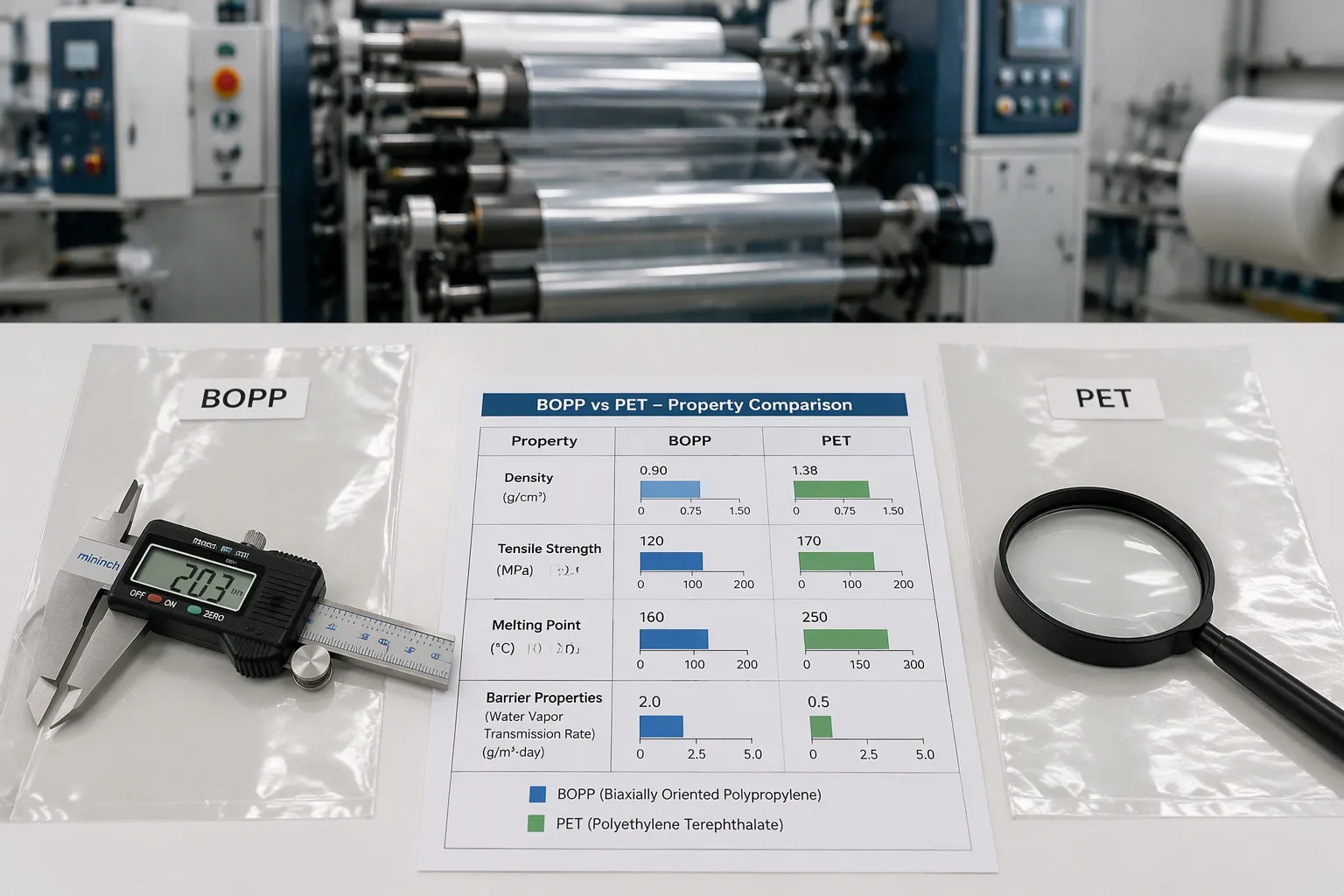
BOPP and PET look close in price, but they act very differently on a converting line. A buyer who compares them on stiffness, heat resistance, and moisture behavior will see where each one fits.
Stiffness, Barrier, and Printability
Published film comparisons note that PET film advantages include tensile properties, dimensional stability, and thermal stability, while BOPP gives high stiffness and oriented strength at lower material density. A published side-by-side comparison reports the following values:
| Property | BOPP Film | PET Film |
|---|---|---|
| Density (g/cm³) | 0.90-0.91 | 1.38-1.40 |
| Tensile Strength (MPa) | 130-180 | 180-250 |
| Melting Point (°C) | 160-170 | 250-260 |
| Water Vapor Transmission (g/m²/day) | 3-6 | 15-25 |
| Oxygen Transmission (cc/m²/day) | 1500-2500 | 50-130 |
The table shows two things at once. BOPP leads on moisture, with a water vapor transmission rate of 3-6 g/m²/day at 38°C and 90% RH against 15-25 for PET. That gap makes BOPP's moisture barrier properties roughly three to five times stronger at equal thickness. PET answers with oxygen: an oxygen transmission rate of 50-130 cc/m²/day against 1500-2500 for BOPP. Neither polymer name alone gives a complete high-barrier package. Coating and metallization decide the final barrier performance.
Printability favors BOPP in consumer graphics. Published converting guidance describes BOPP as well suited to printing, coating, and lamination, and its glossy surface supports vibrant graphics for branding-led work. BOPET film applications in printing and lamination cover the industrial side, where converters can metallize or coat PET for metallic effects or enhanced barrier performance.
Flexible Packaging and Label Fit
BOPP suits flexible packaging and label stock. Its low density means a given weight covers more surface area, a real factor for buyers who purchase film by weight. High-volume, thin-margin products with shorter shelf-life targets usually land on BOPP as the more economical base. The crisp, stiff feel at light weight suits snack wrappers, overwraps, and pressure-sensitive labels.
PET base film fits labels that must survive heat, chemicals, or tight registration. Very low shrinkage supports precision graphics and barcodes, and the higher tensile modulus holds dimension through demanding press runs. A converter printing durable asset tags or industrial labels will often find PET the more stable base, while a converter printing promotional labels for room-temperature retail will find BOPP sufficient.
Cost and Compliance Notes
Cost positioning is straightforward. Published label comparisons note that BOPP is lower-cost and less dense, while PET commands a price premium per square meter, driven by higher density and more demanding processing. Another published comparison adds a useful counterpoint: PET often runs at a thinner gauge for the same performance, which partly offsets the price gap. Buyers should compare cost per finished unit, not cost per kilogram.
Heat ratings shape compliance choices. Published figures place BOPP continuous use at roughly 100-110°C and PET at roughly 150-175°C. A product that passes through a heat tunnel or a high-temperature drying oven needs the higher ceiling. A room-temperature application rarely does. Seal settings follow the same logic: BOPP heat seals at lower temperatures with short dwell times, while PET needs higher temperatures and longer dwells for equivalent seal strength. That difference affects line speed and energy use, so it belongs in the total-cost comparison.
On WVTR performance, the choice depends on what the package protects. A moisture-sensitive food benefits from BOPP's lower WVTR. An oxygen-sensitive product benefits from PET's much tighter oxygen barrier. Laminating the two together is common practice, and the structure then carries both strengths. Neither base carries a universal compliance advantage; the applicable standard for the end product decides which certificates and test data the buyer must request.
Comparing PET and BOPP for a Converting Line?
Send the gauge, print process and barrier target to confirm which base and surface treatment fit the run.
PET Base Film vs PVC Film
PVC is a good choice for shrink and clarity work, and PET is a good choice for stability and heat. Looking at them side by side shows where each base does the job better.
Shrink, Clarity, and Heat Limits
Shrink performance is what separates the two materials. PVC shrinks at low temperatures and forms tight, clear wraps around complex shapes. That mix of high clarity and easy shrinkage keeps PVC in demand for visual packaging. PET base film does not shrink the same way, and formulators use it where the film must hold its shape instead.
Heat limits draw a clear line. Published comparisons list a service temperature range of -70 to +60°C for PVC and -70 to +150°C for PET. The 100 micron PET film guide places continuous PET operation between roughly 105 and 150°C, with short-term exposure up to 220°C during processing. A product that sees steam, hot filling, or a drying oven therefore favors PET. A product that stays cool favors PVC, which delivers its clarity at a lower thermal ceiling.
Shrink Sleeves and Specialty Uses
Shrink sleeves remain PVC's home ground. The material conforms to curves, handles tight radii, and keeps graphics sharp after shrinkage. Converters value that behavior for beverage bottles, caps, and contoured containers. PVC also serves specialty clarity applications where the film must disappear against the product.
PET film fits a different set of jobs. Its dimensional stability suits labels, insulation, and printed electronics that cannot tolerate movement. The same stiffness supports precision converting at tight registration. Neither material wins outright; the sleeve on a curved bottle and the liner inside a motor call for different properties. Buyers should match the base to the shape and the thermal cycle, not to a general preference.
Regulatory Trends and Cost
Regulatory attention around film materials continues to shift, and buyers now review material declarations earlier in the design cycle. The trend favors bases with well-documented test data and recognized certifications. PET carries a long record in electrical and industrial standards, which helps in regulated product categories. PVC remains widely used and compliant in its established applications, and suppliers continue to document its performance.
Cost positioning follows the same pattern as performance. PVC generally costs less per unit and shrinks with less energy, which supports high-volume sleeve programs. PET carries a higher material price but offers a wider thermal window and stronger mechanical stability. A buyer who weighs total cost per finished unit will often find the cheaper base wins on simple shrink work and the stable base wins on demanding thermal or electrical duty. The barrier properties of each film also depend on coating, so the base choice sets the starting point rather than the final moisture protection.
PET Film vs PEN Film
PEN and PET are both made from a polyester base, and how polyester film materials are classified sets out the family; the two films handle heat very differently. If buyers compare them on heat, strength under load, and cost, they will see why PEN is used for extreme jobs and why PET film is still the common everyday choice.
Heat Resistance and Mechanical Strength
Polyethylene naphthalate has a naphthalene ring in its structure, and that ring lifts every heat-related number. Published thermal comparisons report that PEN starts to break down at about 350–370°C, while PET starts at about 280–300°C. The glass transition temperature shows the same gap: about 120°C for PEN, which is roughly 40°C higher than PET's 75–80°C. Supplier data cited in those comparisons puts PEN's continuous use temperature at 180°C and its glass transition as high as 125°C, while another source reports a decomposition temperature above 400°C.
| Property | PET | PEN |
|---|---|---|
| Thermal degradation onset | around 280–300°C | around 350–370°C |
| Glass transition temperature | around 75–80°C | around 120°C |
| Continuous use temperature | Not specified | reaching 180°C |
| Mechanical retention at 150°C | Not specified | tensile strength above 80% |
How well each film keeps its strength under load is the key difference. Published data reports that PEN holds tensile strength above 80% at 150°C. That extra margin matters in electronics packaging, where temperatures can go above 150°C and the film must keep its shape and barrier performance. Standard polyethylene terephthalate films soften sooner and lose stiffness faster in the same conditions.
High-Temperature and High-Voltage Uses
Capacitor design gives the clearest rule for choosing between them. Reference material on film capacitors notes that PEN film capacitors are preferred over PET when the surrounding operating temperature stays above 125°C all the time. A special PEN high-voltage dielectric also keeps strong electrical properties through life tests at high voltages and 175°C. Designers working near those limits choose PEN, while cooler circuits stay with PET.
The barrier question follows the same logic. Heat speeds up moisture and gas permeation, so a base that resists thermal creep protects its barrier layer longer. PEN keeps that barrier intact at high temperature, and PET covers the large middle ground of room-temperature and moderate-heat products. Neither choice is wrong; the operating profile decides.
Premium Cost Positioning
PEN costs more, and the reason comes from how it is made. One market report links high production costs to complex polymerization and expensive raw materials, and notes that smaller production volumes and limited global capacity block economies of scale. Cost sensitivity in packaging and electronics keeps it from wider adoption.
PET sets the commercial reference point. Market data reports long-term PET overcapacity, with roughly 43 million metric tons of nameplate capacity in 2025, and that softness limits the premium PEN can command in packaging, tape, and general-purpose work. For most mainstream applications, PET film stays the balanced, cost-effective choice. PEN earns its price only where heat or voltage demands it.
PET vs Paper-Based Film
Moisture, Tear, and Surface Smoothness
Paper-based film acts very differently from PET film when water gets involved; the PET film roll guide describes the polymer base and its handling. Published comparisons note that PET keeps moisture out because the polymer itself does not soak up water the way paper does. An uncoated paper stock breaks down when it touches water. Moisture sensitivity is paper's most common failure mode. Even coated papers can wrinkle, swell, or fall apart.
Tear behavior shows the same split. Published label guidance reports that paper does not hold up on uneven surfaces with tight curves or repeated flexing. PET film, on the other hand, resists tearing and punctures across temperature ranges. Surface smoothness also favors the polymer base. Paper fibers create a rougher face that affects print and coating uniformity. Paper offers no similar barrier against water.
WVTR Performance Compared
The water vapor transmission rate measures moisture passing through a film over a set area and time. A published packaging study reports a WVTR of 25.80 g/m²/day for a paper tray film, compared with 3.96 g/m²/day for a PET sample. The study attributes the gap to the porosity of the paper-based layer, which lets vapor spread through more easily. The WVTR gap between the two bases is large.
That difference shapes wvtr performance targets, and the water vapor transmission rate of a paper base goes up with fiber porosity. A product with strict moisture barrier characteristics needs a dense base. Paper depends on coatings and laminations to reach similar barrier performance, and those layers add weight and process steps. What PET film products are used for lists the alternative constructions. Buyers comparing moisture barrier properties should test the finished structure, not just the base, because the base sets the barrier floor. A lower WVTR keeps moisture away from sensitive goods.
Sustainability Fit and Cost
Sustainability is a question of application fit. Published packaging guidance notes that paper wins on curbside recyclability and simple end-of-life handling. Flexible plastic structures, though, deliver barrier performance in thin, lightweight formats that paper-only structures struggle to match.
Cost favors neither base across the board. Cellulose film generally shows lower mechanical strength and higher production costs than PET. Cellulose film also needs extra coating steps to get close to the barrier of a polyester base. Cellulose film suits dry products with modest barrier needs. Cellulose film loses ground where moisture protection drives product waste. Cellulose film still earns a place where brands put end-of-life simplicity first. A converter who specifies cellulose film for a wet environment should expect a short service life. Cellulose acetates and polyester sit at opposite ends of that trade-off, and buyers should weigh the full structure. Transport emissions follow weight, and paper formats generally weigh more per square meter.
Selecting a Base for Heat or Moisture Duty?
Share the operating temperature, WVTR target and converting steps to line up the film grade and documentation.
Quick Selection Guide
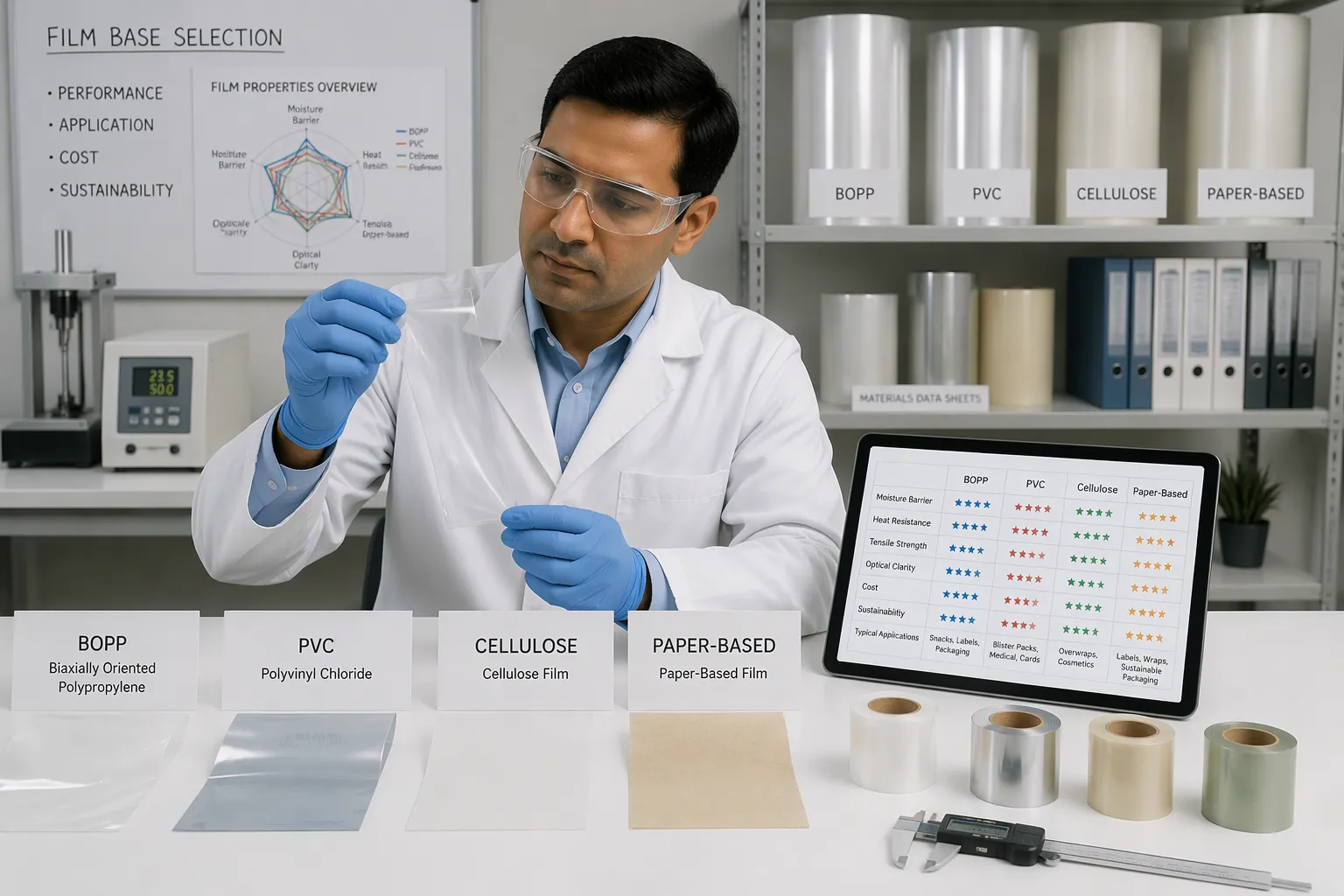
The four criteria from earlier — technical performance, application fit, compliance, and cost — work as a fast filter here. A buyer can run any candidate base through them in order and reach a short list in minutes. The guide below applies that same logic to common scenarios and stays within the materials already compared.
Packaging and Labeling Scenarios
Packaging decisions usually start with the moisture question. A product that spoils when damp needs a low water vapor transmission rate. BOPP delivers the strongest moisture barrier properties of the plastic bases reviewed, at 3-6 g/m²/day. A product that oxidizes instead needs a tight oxygen barrier. PET film answers there with 50-130 cc/m²/day against 1500-2500 for BOPP. Laminating the two carries both strengths into one structure.
| Scenario | Best-fit base | Why it fits |
|---|---|---|
| Snack wrappers, overwraps, promotional labels | BOPP | Low density, high stiffness, strong moisture barrier, lower cost per square meter |
| Durable asset tags, industrial labels, tight-registration graphics | PET | Very low shrinkage, high tensile modulus, heat ceiling near 150-175°C |
| Shrink sleeves on contoured bottles | PVC | Low-temperature shrink, high clarity, lower energy use |
| Dry goods with modest moisture needs and end-of-life simplicity as a priority | Paper-based film | Curbside recyclability, though coatings are needed to approach plastic barrier levels |
Heat exposure settles the rest. A label that passes through a heat tunnel or drying oven needs the PET ceiling. A room-temperature retail label rarely does. Cellulose film suits dry products with modest barrier needs. Cellulose film loses ground wherever moisture protection drives product waste. A converter specifying cellulose film for a wet environment should expect a short service life.
Electronics and Industrial Scenarios
Electrical and industrial work leans heavily on PET. Published product summaries note that BOPET films provide strong electrical insulation with high dielectric strength and low dielectric loss factor, which suits electronic and electrical components. The same summaries place BOPET thermal stability at -70°C to 150°C, with a melting point often above 260°C and low heat shrinkage. That window covers most motor, transformer, and flexible circuit duty.
Solar and energy storage add their own demands. BOPET film serves as a backsheet material in solar panels, supplying electrical insulation and environmental protection, with UV resistance and durability for long outdoor service. The same material appears in separators and insulation layers in lithium-ion batteries and film capacitors, where tight thickness control and dielectric strength matter for safety, cycle life, and compact design. Anti-static treatments protect devices from damage and dust, and flame retardant grades slow fire spread.
Compliance closes the loop for this group. Electronic applications often call for UL 94 V-0 flammability ratings along with RoHS and REACH declarations, so a buyer should confirm those documents before qualification. A base without them stalls the project regardless of performance.
PEN enters only at the thermal edge. Capacitor designs that run above 125°C continuously call for PEN, and cooler circuits stay with PET. The water vapor transmission rate also deserves a check in sealed electronics. Heat speeds permeation, and a base that resists thermal creep protects its barrier layer longer. Buyers should set a WVTR target from the product's sensitivity, then test the finished structure rather than the base alone.
Two PET base film grades from the electrical insulation range are shown below; both rely on the dimensional stability and heat resistance described above.

6020 Universal PET Film
Transparent polyester base film for electrical insulation and laminating, with UL-listed grades.
View Product
6023D Thick PET Film
Thick polyester film in the 300–600 µm range for insulating spacers and mechanical support.
View ProductBalancing Budget and Compliance
Cost comparisons should run per finished unit, not per kilogram. BOPP covers more area per kilogram at its lower density. PET often runs at a thinner gauge for the same performance, which narrows the gap; the PET film thickness and colour selection guide explains how that gauge is chosen. PVC shrinks with less energy, which supports high-volume sleeve programs. PEN carries a premium tied to complex polymerization and limited capacity, so it earns its price only where heat or voltage demands it.
Compliance and budget meet in the documentation. A base with recognized certificates reduces qualification time, and that saved time carries real value. The wvtr of the chosen structure, the heat ceiling, and the certificate file together decide whether a low-cost base is truly cheaper. A buyer who checks all three avoids the common trap of a cheap film that fails late in testing.
No single film base suits every job. PET base film offers a balanced mix of strength, heat resistance, and cost, while BOPP, PVC, PEN, and paper each work better in certain niches. The four-criteria framework — technical performance, application fit, compliance, and cost — gives buyers a checklist they can reuse for any material. A strong moisture barrier points toward BOPP; a tough thermal cycle points toward PET; a curved shrink sleeve points toward PVC. Buyers who have confirmed PET base film fits their needs can ask the supplier for the test reports and certificates that match the application, as the range of duty in applications of BOPET polyester film shows. Application requirements and regulations will keep reshaping base selection, so teams should revisit the checklist as products evolve.
Need a Gauge and Certificate Set to Match?
Request the datasheets, UL and RoHS documentation and thickness options for the grade you plan to qualify.
FAQ
How does film base identification work in practice?
Identification begins with edge markings and simple handling checks. Archival guidance on film supports notes that acetate stock often carries a SAFETY edge print, nitrate may carry NITRATE markings, and polyester can be identified between crossed polarising filters. A laboratory spot test can confirm nitrate in a conservation setting. PET base film does not need that test, because its dimensional stability and heat resistance already set it apart from older stocks.
Why does film base deterioration matter for long-term storage?
Deterioration changes a base's chemistry, not just how it looks. A cellulose nitrate film can give off acidic gases as it ages, and nitrate decomposition speeds up once it starts. Acetate film base shows a related pattern called vinegar syndrome. Cool, dry storage of film base photographic materials slows both processes and protects nearby items.
Which film base types appear in photographic collections?
Collections usually hold three families. A nitrate film base led early motion picture stock. An acetate film base took its place, and polyester supports, described in the PET film roll guide, have predominated in motion picture film since the 1990s. Each film base material ages in its own way, so a conservator identifies the stock before setting conditions for preservation.
How does wvtr affect preservation of film-based photographic materials?
The wvtr measures moisture passing through a film over a set area and time. A high wvtr lets more water reach the emulsion, and moisture drives hydrolysis in an acetate-based photographic film. Conservators therefore track wvtr along with temperature and humidity when they plan storage for film base photographic materials.
Do cellulose acetates and polyester need different storage?
Yes. Cellulose acetates and polyester react differently to heat and moisture. An acetate film base needs cooler, drier conditions to slow acid buildup, while polyester stays stable in a wider range. Cellulose film also shows lower mechanical strength than polyester, so handlers give older acetate reels more physical support during preservation work.
Where does cellulose film still fit today?
Cellulose film suits dry products with modest barrier needs. It generally shows lower mechanical strength and higher production costs than PET, and it needs extra coating to get near polyester barrier levels. Buyers who choose cellulose film for a wet environment should expect a short service life.
What role does PET base film play in modern preservation?
Polyester film frequently asked questions covers PET base film, which offers high tensile strength, low moisture absorption, and a heat ceiling near 150–175°C. These traits support long-term storage of film-based photographic materials and industrial imaging alike. A conservator who confirms the stock is polyester can plan preservation around a stable, well-documented base.
References and Notes
Standard test method for water vapor transmission through plastic film — the measurement basis for WVTR figures (astm.org, accessed 2026-11-10)
Archival guidance on film supports — nitrate, acetate and polyester identification, vinegar syndrome and cold storage (archives.gov, accessed 2026-11-10)
Reference material on film capacitors — PEN versus PET at sustained temperatures above 125°C (wikipedia.org, accessed 2026-11-10)
A published packaging study — paper tray WVTR of 25.80 g/m²/day versus 3.96 g/m²/day for PET (ncbi.nlm.nih.gov, accessed 2026-11-10)
Data notes: the tensile, density, melting point, transmission and thermal values in the four tables are published comparison figures for representative grades, not specification limits; WVTR depends on test conditions (38°C, 90% RH where stated), thickness, coating and metallization. The 43 million metric ton capacity figure and the PEN cost explanation come from single-source market reports. Manufacturer-stated capacity, production line counts, thickness ranges and certification lists should be confirmed on the current datasheet.
Internal links: all original links to bopet-film-china.com are preserved, with anchor text rewritten to describe the destination page.