


What Are the Main Applications of PET Base Film
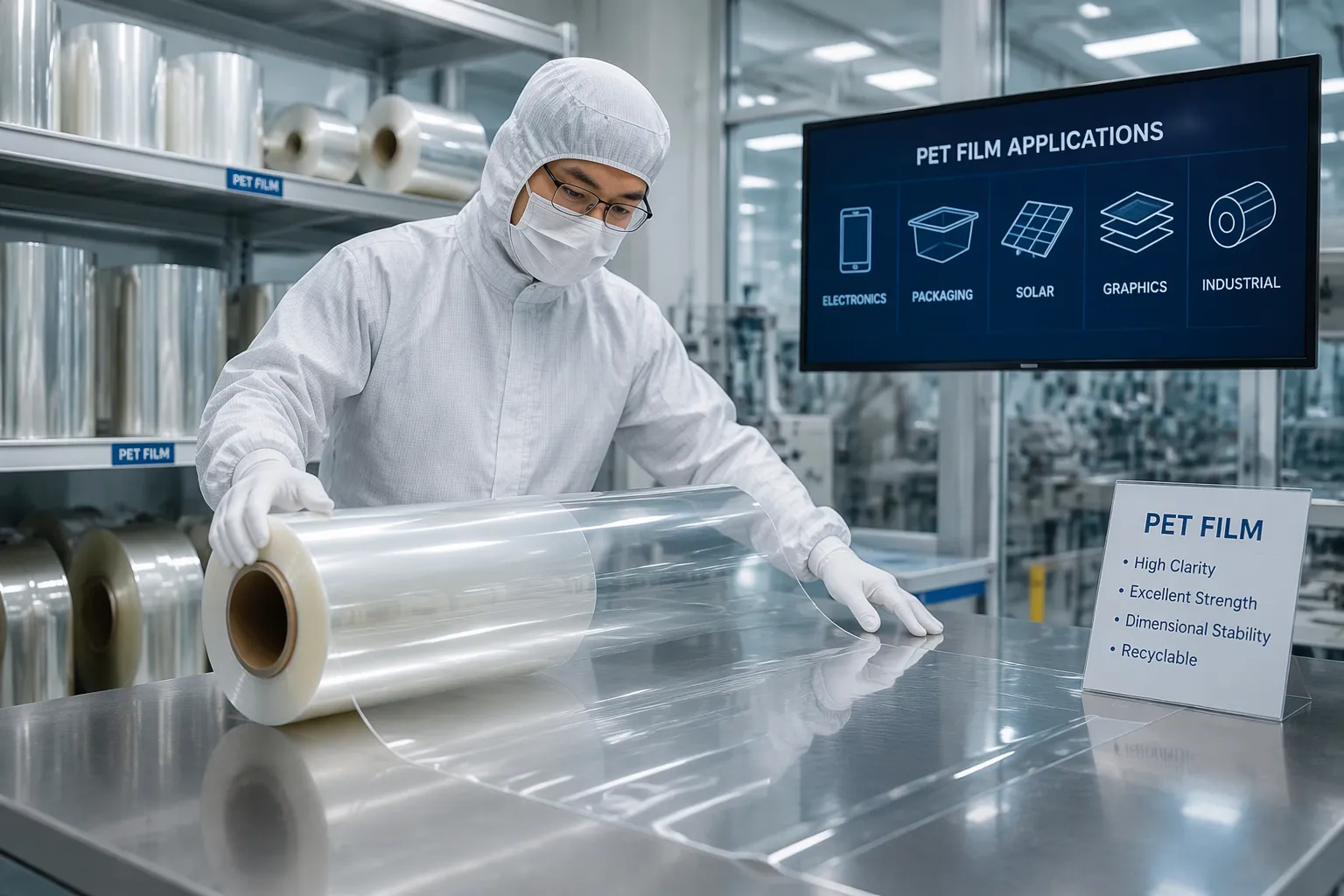
PET base film, or biaxially oriented polyester film, is used as a substrate for coatings, adhesives, printing, and barrier layers. Yuxing supplies four film families, optical grade, electrical insulation, functional industrial, and surface appearance, into six application areas: optoelectronic displays, electrical insulation, consumer electronics, solar and new energy, automotive and decoration, and medical and textile.
Key Takeaways
PET base film is a strong, clear substrate, not usually the finished surface; coatings, inks, and adhesives are applied to it downstream.
Yuxing groups its films into four families: optical grade, electrical insulation, functional industrial, and surface appearance.
The six application areas on this site are optoelectronic displays, electrical insulation, consumer electronics, solar and new energy, automotive and decoration, and medical and textile.
Display films demand low haze, high transmittance, controlled shrinkage, and coating adaptability.
Insulation films demand dielectric strength, thickness consistency, and UL recognition; the published 6023D-1 range is 61 to 147 V/µm.
Solar films serve PV backsheet core and outer layers, where hydrolysis and UV resistance determine outdoor life.
Automotive films serve window tint, paint protection carriers, and IMD/IML decoration; medical films serve imaging, test strips, and specialty textiles.
Start from the application, then choose thickness, surface treatment, and compliance documents.
Optoelectronic Displays
Optical-grade BOPET film is the base layer behind diffuser rolls, reflector films, brightness enhancement films, and display coating processes. The overview of optical film technology explains how these layers work inside a backlight stack, and the main applications of BOPET polyester film place display uses in the wider material context. An explanation of what BOPET film is helps separate the base film from the converted optical products made from it.
Display Stack Roles
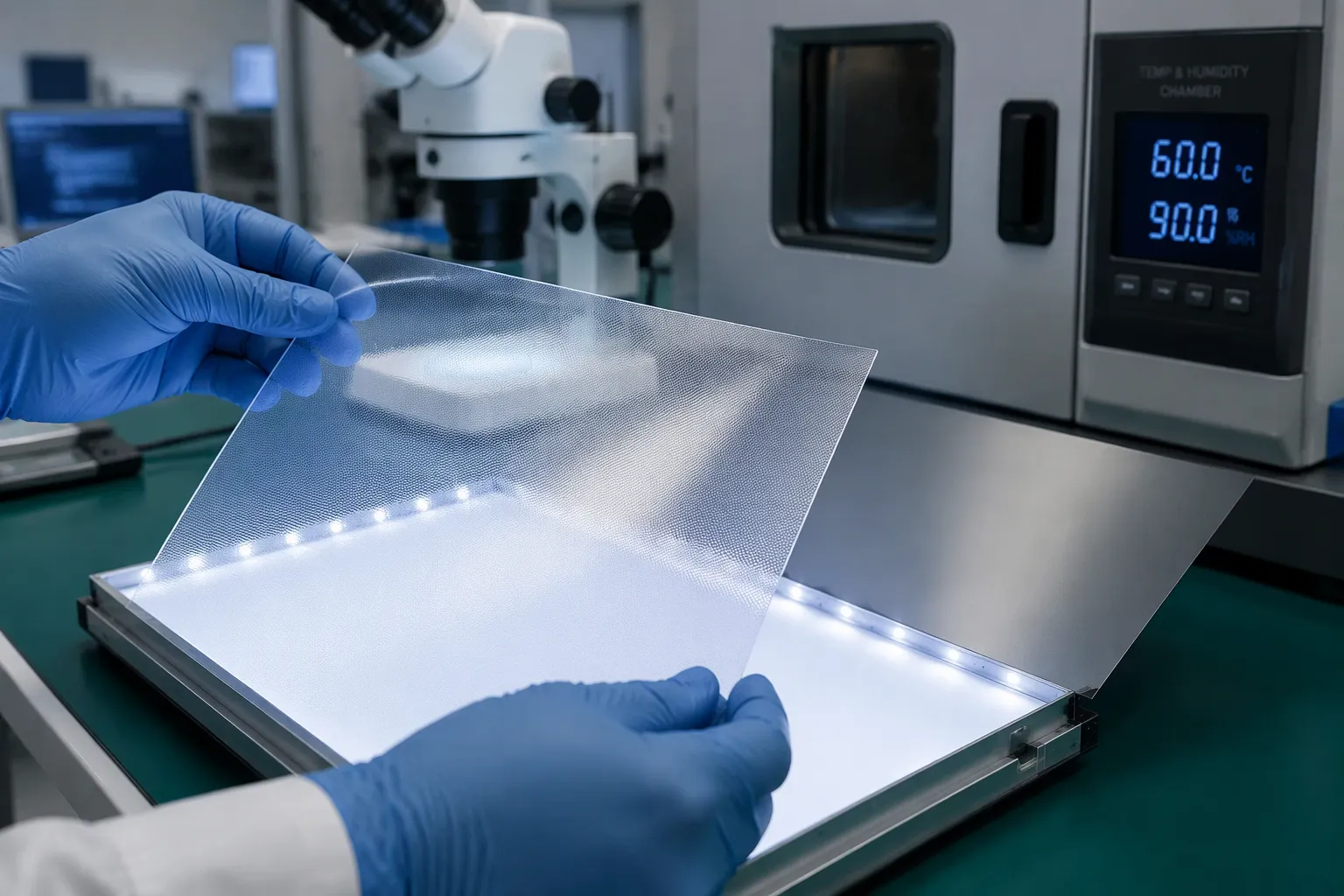
In an LCD backlight unit, a diffusion film spreads light from an edge or back source across the screen, scattering it evenly and hiding bright spots. A reflector film sends escaping light back toward the viewer, raising brightness without extra power. Brightness enhancement films add prism or other optical structures that need a stable coating surface. Yuxing's display line also supplies substrates for industrial monitors and display modules, where thickness uniformity and roll appearance matter as much as raw optical data.
Pre-coated films carry a thin working layer, such as a hard coat or adhesion primer, applied before the film enters the display assembly line. One published reflective grade, the F40 series, lists 96% reflectivity at 550 nm and across the 400 to 700 nm band. Buyers should request the datasheet for the exact grade rather than assume one optical film suits every stack, because each role in the stack asks for a different balance of haze, reflectivity, and thermal shrinkage.
Optical Clarity and Dimensional Control
Display films are thin, often well under 100 µm, and thin layers distort easily when heated or pulled. Biaxial orientation aligns polymer chains in two directions, so the finished film keeps its shape when warmed. A display film goes through coating, lamination, and slitting, and each step adds heat; a film that expands or shrinks would misalign with the pixel grid or wrinkle in the stack.
Haze and luminous transmittance are the two optical figures most often reported for these substrates, measured under the standard test method for haze and luminous transmittance of transparent plastics. Cleanliness is equally important: microscopic surface defects can spoil brightness uniformity or coating stability, so dust-controlled production and automatic inspection are part of the grade specification rather than optional extras.
Confirm Optical Data Before Coating
Share the backlight architecture and coating route to receive a grade with haze, transmittance, shrinkage, and surface defect data.
Electrical Insulation
Electrical-grade PET film works as slot liners, phase insulation, transformer layers, and cable wrapping in motors, power systems, and battery pack enclosures. The electrical insulation film primer covers the test methods behind those ratings, and UL recognition tells designers the film has passed recognized safety testing for electrical equipment.
Motors, Transformers, and Cable Wrapping
Industrial insulation films must hold dielectric strength, tensile performance, and thickness consistency through high-speed coil winding, narrow slot insertion, and composite laminating. One published insulation datasheet, the 6023D-1 grade, lists electrical strength from 61 to 147 V/µm depending on thickness; that range lets designers meet insulation requirements with a thin wall, saving slot space and improving motor efficiency.
EV motors and high-voltage transformers add voltage spikes and operating heat to the requirement, while battery pack enclosures add chemical exposure from lubricating oils or impregnating resins. Ultra-thick film grades take the same material into transformer layer insulation and barrier parts. Buyers should compare breakdown voltage, shrinkage, and heat-aging data for the exact grade instead of relying on a category average.
Flexible Laminates and Spacers
For rigid spacers and flexible laminates, insulation film is bonded to other layers and die-cut into components. The film must resist tearing during winding and stay flat during lamination, and its surface must accept the adhesive system used in the laminate. Typical test data supplied for these grades include tensile strength, elongation, breakdown voltage, and heat-aging performance.
Solar and New Energy
PV backsheet films use PET as the structural core or as a weather-resistant outer layer. The site's solar and new energy application page sets out the material requirements: mechanical strength, dimensional stability, insulation performance, and bonding reliability must survive years of temperature, humidity, UV radiation, and electrical stress.
Backsheet Layer Structure
In a composite backsheet, the core layer contributes insulation, mechanical support, and dimensional stability, while the outer functional layer resists environmental aging. Hydrolysis-resistant PET is specified for the core, and UV-resistant or high-reflectivity grades for the outer layer; clear grades also serve flexible solar cells and thin-film modules where optical clarity and stable processing matter.

Durability and Qualification
Damp-heat aging, PCT, UV aging, and lamination are the recurring test conditions in this application. Buyers should ask which test conditions were used for a claimed outdoor life and confirm the film's bonding behavior with the chosen encapsulant; a grade that passes one lamination process may not behave the same way in another. Long service life comes from matching grade, layer position, and module design together.
Consumer Electronics
The consumer electronics application page describes PET substrates for smart devices, wearable technology, OLED displays, touch panels, and structural shielding parts. These uses demand surface quality, optical transparency, and dimensional consistency through high-temperature coating, die-cutting, and lamination.
OLED and Touch Panel Substrates
High-clarity transparent PET films serve as structural support layers in flexible OLED displays, while other grades form the base material for industrial protective films and LCD monitor protective coatings. Suppliers provide transmittance, haze, surface tension, and thermal shrinkage data because each of those figures affects how the film behaves on a coating line or at a die-cutting station.
Membrane Switches and Flexible Circuits
Low-shrinkage PET grades are used in membrane switches and flexible printed circuits, where silver paste printing and subsequent heating must not deform the substrate. Insulation laminates bond the film to copper or other conductors, and the film's surface accepts conductive inks and adhesives after suitable treatment. Roll dimensions, thickness tolerances, and surface treatments can be customized to match high-speed coating lines.
Automotive and Decoration
The site's automotive and decoration application page covers window films, paint protection film carriers, IMD/IML decoration, and architectural solar control films. These products ask for high clarity, low haze, dimensional stability under heat, coating adhesion, stable release behavior, and resistance to yellowing outdoors.
Window Film and Paint Protection Carriers
Window film uses optical-grade PET as a carrier for dyed, coated, metallized, or ceramic heat-rejection layers. One published window and paint-protection substrate grade, CY20CM, lists transmittance of 89.81% and 89.54% in its two reported directions and clarity of 99.8%. Paint protection film uses PET as a carrier or protective layer for TPU casting and coating, where flatness and release behavior control yield.
IMD, IML, and Panel Decoration
Colored, matte, and chemically treated films provide interior panels, decorative trims, and printed films for automotive and appliance surfaces. The surface appearance film family collects these options, including opaque black light-blocking substrates, blue medical imaging bases, and matte finishes for low-glare surfaces. Buyers should confirm color consistency between batches, since decorative parts are often assembled from several production lots.
Medical and Textile
The medical and textile application page covers medical imaging base films, IVD consumables, chemically treated films, printing films, and specialty textile films. Clean surface quality, stable treatment behavior, controlled defects, and roll consistency drive selection here.
Medical Imaging and Diagnostic Consumables
Blue-tinted or transparent PET bases are used in medical imaging and related coated film products; the film must stay flat in the reader and pass light or laser energy predictably. Blood glucose test strips use a grade with heat resistance, surface flatness, and stiffness so the reagent layer forms evenly. For regulated or safety-sensitive products, customer-side validation is recommended, and batch records and typical test data should be confirmed with the supplier.
Specialty Textile Film
Specialty textile film is used for heald components in water-jet, air-jet, and rapier looms, where mechanical strength, punching performance, and wear resistance matter more than optics. This is a different selection problem from display or insulation film, and it illustrates why the same base polymer can be supplied in very different grades.
Functional Industrial Films
The functional industrial film family covers films engineered for coating adhesion, printing, labeling, and harsh environments. Surface treatment is often the deciding factor, because the film's job is to accept a downstream coating or adhesive reliably.
Chemical Treated Films and Printing Bases
In-line chemical treatment raises surface energy so inks and adhesives bond consistently. The chemical-coated polyester film range includes grades for printing and lamination, and the high-definition printing base film is one example. Printing and imaging questions, including inkjet methods on transparent PET, are covered in the comparison of inkjet printing with traditional methods.
Labeling, Tape, and Decorative Bases
Durable industrial labels and flexible-circuit printing use flat, ink-receptive films with controlled thickness. Tape bases use opaque black or white films for light blocking, and matte grades provide low-glare surfaces for decorative and release applications. These are substrate rolls rather than finished labels or tapes, so converters should confirm coating compatibility and die-cutting behavior on their own equipment.
Trial the Treatment on Your Converting Line
Request an A4 sample of the treated grade and run a coating or printing trial before committing to tonnage.
Three product families recur across the applications above; each linked page lists the grades and thicknesses relevant to a specification.

Optical Grade BOPET Film
Films for diffusion, reflection, and pre-coating inside display stacks, where transmittance, haze, and dimensional control drive selection.
View Product
Electrical Insulation Film
PET insulation film for motor slot liners, transformer layers, and barrier parts, with dielectric strength across a wide thickness range.
View Product
Reflective Film
High-reflectance PET film for backlight units and display layers, with reported reflectivity of 96% in the visible band.
View ProductChoosing a Film Grade
Four Product Families
Yuxing organizes supply into four families rather than a simple standard and specialty split. Optical grade BOPET films control light diffusion, reflection, and surface cleanliness for display stacks. Electrical insulation films carry recognized dielectric ratings for motors and transformers. Functional industrial films add surface treatment and weathering resistance for coating, printing, and solar uses. Surface appearance films supply opaque, matte, and colored bases for tapes and decoration. Starting from the family narrows the field before thickness and treatment are discussed.
A general-purpose film would struggle in a display stack, and an optical film would be an expensive choice for an industrial label. Buyers should start from the end use and work backward to the grade. For the substrate itself, the definition and key properties of PET base film give the common starting point.
Thickness and Mechanical Fit
Thin films suit displays, flexible circuits, and graphic layers where space is tight; thicker films add stiffness, puncture resistance, and dielectric strength for insulation and heavy-duty parts. The manufacturer's published range runs from 36 to 500 µm, with individual product series occupying narrower bands. Ultra-thick grades serve transformer and motor insulation duties.
Thickness also affects converting: very thin film needs careful tension control, and very thick film needs more force to slit and wind. Tensile strength and elongation are reported under the standard test method for tensile properties of thin plastic sheeting. Buyers should confirm thickness against the process equipment, not just the end product.
Surface Treatment and Documentation
Untreated film has a smooth, inert face, so inks and adhesives may not bond well. Corona or chemical treatment raises surface energy for printing and lamination, primer coatings give a stable base for inks, and silicone release systems control peel force in protective and carrier applications. The right treatment depends on the next step: coating work needs wet-out, labeling needs adhesive anchorage, and protection needs controlled release.
Yuxing reports CNAS accreditation and states RoHS and REACH compliance; buyers should request the documents that apply to their own grade and market. Confirm grade, thickness, treatment, and test conditions in writing, and run a trial on production equipment before a volume order.
Get a Grade Schedule for Your Application
Share the application area, thickness, treatment, and compliance target to receive a film schedule rather than a generic product name.
FAQ
What exactly is PET base film?
It is a biaxially oriented polyethylene terephthalate film used as a substrate. Biaxial means the film is stretched in two directions during manufacture, aligning polymer chains and giving the film strength, flatness, and heat resistance.
Which properties matter most when choosing a grade?
It depends on the application area. Displays need low haze, high transmittance, and controlled shrinkage; insulation needs dielectric strength; solar needs hydrolysis and UV resistance; automotive needs coating adhesion and release control; medical needs clean surfaces and batch traceability.
What thickness range is available?
The manufacturer publishes a 36 to 500 µm range, with individual series occupying narrower bands. Thin films suit displays and flexible circuits; ultra-thick grades serve transformer and motor insulation. Buyers should check thickness against their converting equipment.
Why does optical-grade film need tight dimensional control?
Display films pass through coating, lamination, and slitting steps that add heat. A film that expands or shrinks would misalign with the pixel grid, wrinkle in the stack, or curl at the edges, so controlled thermal shrinkage is specified alongside haze and transmittance.
How does surface treatment change performance?
Untreated film has a smooth, inert face. Corona or chemical treatment raises surface energy and improves how ink and adhesive bond to it, primer coatings give a stable base for printing and lamination, and silicone release systems set how easily a protective layer peels away.
What makes a film grade suitable for electrical insulation?
Dielectric strength, thickness consistency, and heat resistance are the key traits. Electrical grades carry UL recognition for motors and transformers, and the published 6023D-1 datasheet lists electrical strength between 61 and 147 V/µm depending on thickness, allowing thin insulation walls.
Can one film type serve both displays and industrial labels?
Not effectively. Optical grades control light diffusion and reflection with tight surface cleanliness and shrinkage limits, while printing and labeling grades focus on ink anchorage and flatness. A general-purpose film would struggle in a display stack, and an optical film would be an expensive choice for a durable label.
What should buyers check before ordering?
Confirm grade, thickness, and surface treatment against the end use and converting line. Ask for compliance documents such as RoHS and REACH; for medical and diagnostic work, request batch records and test data. A trial run on production equipment is the surest test.
References and Notes
ASTM D1003 haze and luminous transmittance standard — test reference for optical figures (astm.org, accessed 2026-11-24)
ASTM D882 tensile properties of thin plastic sheeting — test reference for mechanical figures (astm.org, accessed 2026-11-24)
Data notes: application areas and product families follow the site navigation and application pages. The 36 to 500 µm range, CNAS accreditation, and RoHS and REACH compliance are manufacturer published claims; 61 to 147 V/µm is from the 6023D-1 datasheet and 96% reflectivity from the F40 series. Claims not present on the site, including food and beverage packaging, pharmaceutical blister packs, and membrane filtration supports, were removed.
Internal links: all original links pointing to www.bopet-film-china.com are preserved with anchors matched to each target page.